


Page 388 - Towards Trustworthy Elections New Directions in Electronic Voting by Ed Gerck (auth.), David Chaum, Markus Jakobsson, Ronald L. Rivest, Peter Y. A. Ryan, Josh Benaloh, Miroslaw Kutylowski, Ben Adida ( (z-lib.org (1)
P. 388
J. Kelsey et al.
                          380
                          ThreeBallot Pay-Per-Mark. A simple example of an incentive attack with a
                          machined-marked ThreeBallot device is to pay voters for each mark on a receipt
                          that is acceptable to the vote-buyer. For example, the vote-buyer would offer to
                          pay one dollar for every mark corresponding to a member of the Whig party.
                          A vote-seller would cast a multiballot, choose a receipt based on the number of
                          Whig votes contained on each ballot and present that receipt to the buyer in
                          exchange for payment. If the seller does not vote for the Whigs on any of n total
                          questions, each ballot would contain roughly  n  Whig marks. However, voters
                                                                   3
                          who vote for Whigs on every ballot question would expect to find a ballot with
                          2n  Whig marks. This is ineffective at influencing individual races and does not
                           3
                          work when races are separated from one another.
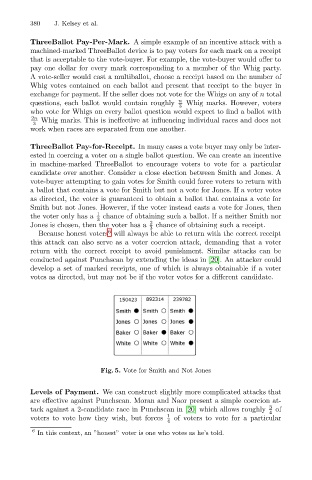
                          ThreeBallot Pay-for-Receipt. In many cases a vote buyer may only be inter-
                          ested in coercing a voter on a single ballot question. We can create an incentive
                          in machine-marked ThreeBallot to encourage voters to vote for a particular
                          candidate over another. Consider a close election between Smith and Jones. A
                          vote-buyer attempting to gain votes for Smith could force voters to return with
                          a ballot that contains a vote for Smith but not a vote for Jones. If a voter votes
                          as directed, the voter is guaranteed to obtain a ballot that contains a vote for
                          Smith but not Jones. However, if the voter instead casts a vote for Jones, then
                          the voter only has a  1  chance of obtaining such a ballot. If a neither Smith nor
                                            3
                          Jones is chosen, then the voter has a  2  chance of obtaining such a receipt.
                                                           3
                                               6
                            Because honest voters will always be able to return with the correct receipt
                          this attack can also serve as a voter coercion attack, demanding that a voter
                          return with the correct receipt to avoid punishment. Similar attacks can be
                          conducted against Punchscan by extending the ideas in [20]. An attacker could
                          develop a set of marked receipts, one of which is always obtainable if a voter
                          votes as directed, but may not be if the voter votes for a different candidate.


                                             Fig. 5. Vote for Smith and Not Jones


                          Levels of Payment. We can construct slightly more complicated attacks that
                          are effective against Punchscan. Moran and Naor present a simple coercion at-
                          tack against a 2-candidate race in Punchscan in [20] which allows roughly  3 4  of
                          voters to vote how they wish, but forces  1  of voters to vote for a particular
                                                                4
                          6
                            In this context, an ”honest” voter is one who votes as he’s told.

