


Page 78 - Towards Trustworthy Elections New Directions in Electronic Voting by Ed Gerck (auth.), David Chaum, Markus Jakobsson, Ronald L. Rivest, Peter Y. A. Ryan, Josh Benaloh, Miroslaw Kutylowski, Ben Adida ( (z-lib.org (1)
P. 78
M. Hirt
                          70
                          What should still be mentioned here is that computational complexity for de-
                          cryption is linear in the size of the cleartext. However, in the context of this
                          work, this issue will not be a problem.
                          3.3  Paillier Encryption
                          Also the probabilistic encryption function of Paillier [Pai99], enhanced by thresh-
                          old setup and decryption [FPS00, DJ01], satisfies all required properties. For an
                          RSA modulus n, this encryption function is n-invertible, and let u be a large
                          prime which is guaranteed to be smaller than the smaller prime factor of n (e.g.,
                          we let n be the product of two secret 512-bit integers, and let u be a fixed 511-bit
                          prime).


                          4   Re-encrypting and Proving Re-encryptions


                          A random re-encryption e of a given encryption e = E(v, α) is an encryption
                          with the same vote v, but a new (independently chosen) randomness α . Such

                          a re-encryption can be computed by adding a random encryption of 0 to e.

                          Formally, a witness ξ ∈ R R is chosen at random, and e = e ⊕ E(0,ξ), i.e.,

                                                 e = R(e, ξ)= e ⊕ E(0,ξ).

                          Due to the homomorphic property of E, the randomness in e is uniformly dis-
                          tributed over R for a uniformly chosen ξ ∈ R R.

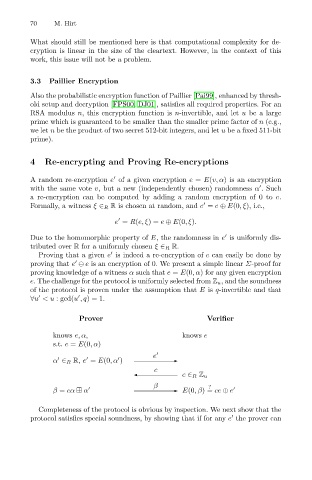
                            Proving that a given e is indeed a re-encryption of e can easily be done by

                          proving that e   e is an encryption of 0. We present a simple linear Σ-proof for
                          proving knowledge of a witness α such that e = E(0,α) for any given encryption
                          e. The challenge for the protocol is uniformly selected from Z u , and the soundness
                          of the protocol is proven under the assumption that E is q-invertible and that


                          ∀u <u :gcd(u ,q)= 1.
                                       Prover                              Verifier


                                knows e, α,                         knows e
                                s.t. e = E(0,α)


                                α ∈ R R,e = E(0,α )         e
                                                            c       c ∈ R Z u
                                                                           ?
                                                            β

                                β = cα   α                          E(0,β) = ce ⊕ e
                            Completeness of the protocol is obvious by inspection. We next show that the

                          protocol satisfies special soundness, by showing that if for any e the prover can

