


Page 83 - Towards Trustworthy Elections New Directions in Electronic Voting by Ed Gerck (auth.), David Chaum, Markus Jakobsson, Ronald L. Rivest, Peter Y. A. Ryan, Josh Benaloh, Miroslaw Kutylowski, Ben Adida ( (z-lib.org (1)
P. 83
75
                                     Receipt-Free K-out-of-L Voting Based on ElGamal Encryption
                          each voter knows the secret key corresponding to his known public key (but the
                          voter is allowed to reveal the secret-key to the coercer). A protocol ensuring so
                          is given in [HS00].
                            Note that all above requirements are uniquely relevant for receipt-freeness.
                          If they are not met, then the proposed voting scheme still achieves all security
                          requirements but receipt-freeness.
                          6.2  Casting a Ballot
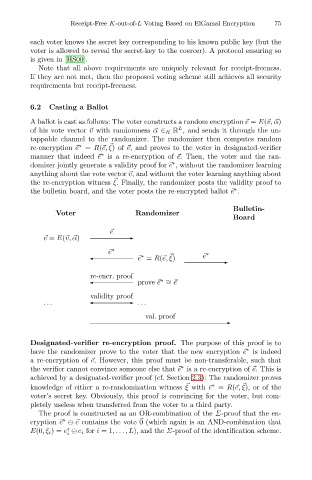
                          A ballot is cast as follows: The voter constructs a random encryption  e = E( v,  α)
                                                                   L
                          of his vote vector  v with randomness  α ∈ R R , and sends it through the un-
                          tappable channel to the randomizer. The randomizer then computes random
                          re-encryption  e = R( e, ξ)of  e, and proves to the voter in designated-verifier
                                       ∗

                                             ∗
                          manner that indeed  e is a re-encryption of  e. Then, the voter and the ran-
                          domizer jointly generate a validity proof for  e , without the randomizer learning
                                                                 ∗
                          anything about the vote vector  v, and without the voter learning anything about
                          the re-encryption witness ξ. Finally, the randomizer posts the validity proof to

                                                                                  ∗
                          the bulletin board, and the voter posts the re-encrypted ballot  e .
                                                                                  Bulletin-
                                 Voter                 Randomizer
                                                                                  Board
                                                 e
                              e = E( v,  α)
                                                ∗
                                                e       e = R( e, ξ)      e ∗
                                                        ∗

                                          re-encr. proof
                                                              ∗ ∼
                                                       prove  e =  e
                                          validity proof
                              ...                      .. .

                                                          val. proof


                          Designated-verifier re-encryption proof. The purpose of this proof is to
                                                                                     ∗
                          have the randomizer prove to the voter that the new encryption  e is indeed
                          a re-encryption of  e. However, this proof must be non-transferable, such that
                          the verifier cannot convince someone else that  e is a re-encryption of  e.This is
                                                                   ∗
                          achieved by a designated-verifier proof (cf. Section 2.3): The randomizer proves
                                                                            ∗
                          knowledge of either a re-randomization witness ξ with  e = R( e, ξ), or of the


                          voter’s secret key. Obviously, this proof is convincing for the voter, but com-
                          pletely useless when transferred from the voter to a third party.
                            The proof is constructed as an OR-combination of the Σ-proof that the en-
                          cryption  e    e contains the vote 0 (which again is an AND-combination that
                                   ∗

                          E(0,ξ i )= e  e i for i =1,... ,L), and the Σ-proof of the identification scheme.
                                    ∗
                                    i

