


Page 81 - Towards Trustworthy Elections New Directions in Electronic Voting by Ed Gerck (auth.), David Chaum, Markus Jakobsson, Ronald L. Rivest, Peter Y. A. Ryan, Josh Benaloh, Miroslaw Kutylowski, Ben Adida ( (z-lib.org (1)
P. 81
Prover
                                                                               Verifier
                                                                       knows e i = E(v i ,α i)
                               knows v i ∈{0, 1},α i
                                     Receipt-Free K-out-of-L Voting Based on ElGamal Encryption  73
                               α   ∈ R R,
                                i,v i
                                              )
                                i,v i      i,v i
                               e   = E(0,α
                               c i,1−v i  ∈ R Z u ,
                               β i,1−v i  ∈ R R,
                                                 )
                                i,1−v i
                               e     = E(0,β i,1−v i
                                                            i,0
                                                           e ,e i,1
                                           c i,1−v i i,1−v i
                                                 e
                                                              c        c ∈ R Z u
                               c i,v i  = c − c i,1−v i  (mod u),

                                                       c i,0 ,c i,1 ,β i,0 ,β i,1  ?

                               β i,v i  = c i,v i  α i   α             c = c i,0 + c i,1 (mod u)
                                              i,v i
                                                                                ?

                                                                       E(0,β i,0 ) = c i,0 e i,0 ⊕ e i,0
                                                                                ?

                                                                       E(0,β i,1 ) = c i,1 e i,1 ⊕ e i,1
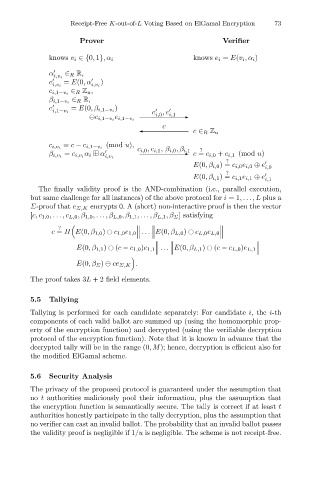
                            The finally validity proof is the AND-combination (i.e., parallel execution,
                          but same challenge for all instances) of the above protocol for i =1,... ,L plus a
                          Σ-proof that e Σ,K encrypts 0. A (short) non-interactive proof is then the vector
                          [c, c 1,0 ,... ,c L,0 ,β 1,0 ,... ,β L,0 ,β 1,1,...,β L,1,β Σ ] satisfying

                                  ?
                                c = H E(0,β 1,0 )   c 1,0 e 1,0  ...  E(0,β L,0)   c L,0e L,0


                                       E(0,β 1,1 )   (c − c 1,0 )e 1,1  ...  E(0,β L,1)   (c − c L,0)e L,1

                                       E(0,β Σ )   ce Σ,K .
                          The proof takes 3L + 2 field elements.
                          5.5  Tallying
                          Tallying is performed for each candidate separately: For candidate i,the i-th
                          components of each valid ballot are summed up (using the homomorphic prop-
                          erty of the encryption function) and decrypted (using the verifiable decryption
                          protocol of the encryption function). Note that it is known in advance that the
                          decrypted tally will be in the range (0,M); hence, decryption is efficient also for
                          the modified ElGamal scheme.
                          5.6  Security Analysis
                          The privacy of the proposed protocol is guaranteed under the assumption that
                          no t authorities maliciously pool their information, plus the assumption that
                          the encryption function is semantically secure. The tally is correct if at least t
                          authorities honestly participate in the tally decryption, plus the assumption that
                          no verifier can cast an invalid ballot. The probability that an invalid ballot passes
                          the validity proof is negligible if 1/u is negligible. The scheme is not receipt-free.

