


Page 235 - Towards_a_New_Malaysia_The_2018_Election_and_Its_6146371_(z-lib.org)
P. 235
220                                                 Wong Chin Huat

                  89 constituencies the opposition coalition won in 2013 averaged 88,981
                  voters, while the 113 constituencies BN won averaged only 52,792 voters, or
                  41 per cent fewer (Chart 11.1).


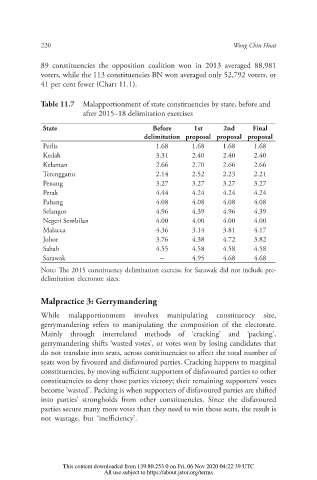
                  Table 11.7  Malapportionment of state constituencies by state, before and
                              after 2015–18 delimitation exercises

                   State                        Before      1st    2nd     Final
                                              delimitation proposal proposal proposal
                   Perlis                        1.68      1.68    1.68     1.68
                   Kedah                         3.31      2.40    2.40     2.40
                   Kelantan                      2.66      2.70    2.66     2.66
                   Terengganu                    2.14      2.52    2.23     2.21
                   Penang                        3.27      3.27    3.27     3.27
                   Perak                         4.44      4.24    4.24     4.24
                   Pahang                        4.08      4.08    4.08     4.08
                   Selangor                      4.96      4.39    4.96     4.39
                   Negeri Sembilan               4.00      4.00    4.00     4.00
                   Malacca                       4.36      3.14    3.81     4.17
                   Johor                         3.76      4.38    4.72     3.82
                   Sabah                         4.55      4.58    4.58     4.58
                   Sarawak                        –        4.95    4.68     4.68
                  Note:  e 2015 constituency delimitation exercise for Sarawak did not include pre-
                  delimitation electorate sizes.


                  Malpractice 3: Gerrymandering
                  While  malapportionment  involves  manipulating  constituency  size,
                  gerrymandering refers to manipulating the composition of the electorate.
                  Mainly through interrelated methods of ‘cracking’ and ‘packing’,
                  gerrymandering shifts ‘wasted votes’, or votes won by losing candidates that
                  do not translate into seats, across constituencies to a ect the total number of
                  seats won by favoured and disfavoured parties. Cracking happens to marginal
                  constituencies, by moving su cient supporters of disfavoured parties to other
                  constituencies to deny those parties victory; their remaining supporters’ votes
                  become ‘wasted’. Packing is when supporters of disfavoured parties are shifted
                  into parties’ strongholds from other constituencies. Since the disfavoured
                  parties secure many more votes than they need to win those seats, the result is
                  not wastage, but ‘ine ciency’.


                        This content downloaded from 139.80.253.0 on Fri, 06 Nov 2020 04:22:39 UTC
                                   All use subject to https://about.jstor.org/terms

