


Page 232 - Towards_a_New_Malaysia_The_2018_Election_and_Its_6146371_(z-lib.org)
P. 232
Malaysia’s First-Past-the-Post Electoral System              217

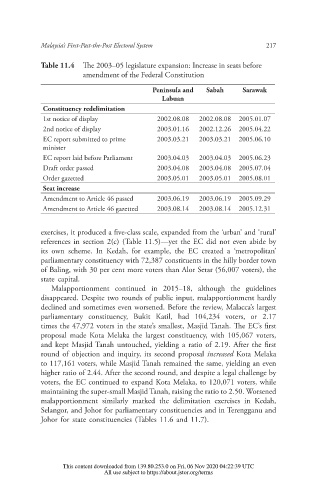
                  Table 11.4   e 2003–05 legislature expansion: Increase in seats before
                              amendment of the Federal Constitution
                                                Peninsula and   Sabah    Sarawak
                                                   Labuan
                   Constituency redelimitation
                   1st notice of display          2002.08.08  2002.08.08  2005.01.07
                   2nd notice of display          2003.01.16  2002.12.26  2005.04.22
                   EC report submitted to prime   2003.03.21  2003.03.21  2005.06.10
                   minister
                   EC report laid before Parliament  2003.04.03  2003.04.03  2005.06.23
                   Draft order passed             2003.04.08  2003.04.08  2005.07.04
                   Order gazetted                 2003.05.01  2003.05.01  2005.08.01
                   Seat increase
                   Amendment to Article 46 passed  2003.06.19  2003.06.19  2005.09.29
                   Amendment to Article 46 gazetted  2003.08.14  2003.08.14  2005.12.31


                  exercises, it produced a  ve-class scale, expanded from the ‘urban’ and ‘rural’
                  references in section 2(c) (Table 11.5)—yet the EC did not even abide by
                  its own scheme. In Kedah, for example, the EC created a ‘metropolitan’
                  parliamentary constituency with 72,387 constituents in the hilly border town
                  of Baling, with 30 per cent more voters than Alor Setar (56,007 voters), the
                  state capital.
                     Malapportionment continued in 2015–18, although the guidelines
                  disappeared. Despite two rounds of public input, malapportionment hardly
                  declined and sometimes even worsened. Before the review, Malacca’s largest
                  parliamentary constituency, Bukit Katil, had 104,234 voters, or 2.17
                  times the 47,972 voters in the state’s smallest, Masjid Tanah.  e EC’s  rst
                  proposal made Kota Melaka the largest constituency, with 105,067 voters,
                  and kept Masjid Tanah untouched, yielding a ratio of 2.19. After the  rst
                  round of objection and inquiry, its second proposal increased Kota Melaka
                  to 117,161 voters, while Masjid Tanah remained the same, yielding an even
                  higher ratio of 2.44. After the second round, and despite a legal challenge by
                  voters, the EC continued to expand Kota Melaka, to 120,071 voters, while
                  maintaining the super-small Masjid Tanah, raising the ratio to 2.50. Worsened
                  malapportionment similarly marked the delimitation exercises in Kedah,
                  Selangor, and Johor for parliamentary constituencies and in Terengganu and
                  Johor for state constituencies (Tables 11.6 and 11.7).


                        This content downloaded from 139.80.253.0 on Fri, 06 Nov 2020 04:22:39 UTC
                                   All use subject to https://about.jstor.org/terms

