


Page 1424 - (ISC)² CISSP Certified Information Systems Security Professional Official Study Guide
P. 1424
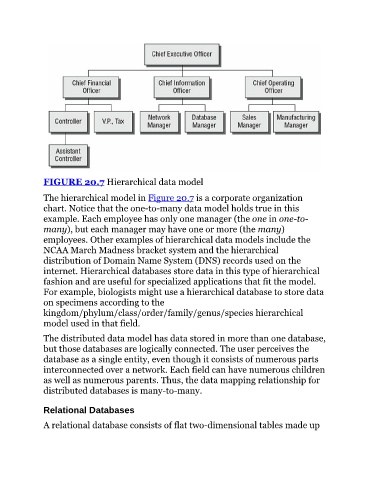
FIGURE 20.7 Hierarchical data model

               The hierarchical model in Figure 20.7 is a corporate organization
               chart. Notice that the one-to-many data model holds true in this
               example. Each employee has only one manager (the one in one-to-
               many), but each manager may have one or more (the many)

               employees. Other examples of hierarchical data models include the
               NCAA March Madness bracket system and the hierarchical
               distribution of Domain Name System (DNS) records used on the
               internet. Hierarchical databases store data in this type of hierarchical
               fashion and are useful for specialized applications that fit the model.
               For example, biologists might use a hierarchical database to store data

               on specimens according to the
               kingdom/phylum/class/order/family/genus/species hierarchical
               model used in that field.

               The distributed data model has data stored in more than one database,
               but those databases are logically connected. The user perceives the
               database as a single entity, even though it consists of numerous parts

               interconnected over a network. Each field can have numerous children
               as well as numerous parents. Thus, the data mapping relationship for
               distributed databases is many-to-many.


               Relational Databases

               A relational database consists of flat two-dimensional tables made up

