


Page 1426 - (ISC)² CISSP Certified Information Systems Security Professional Official Study Guide
P. 1426
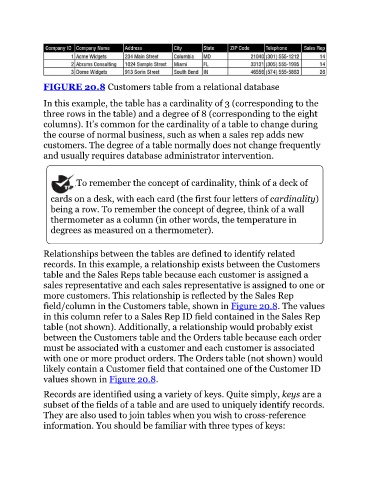
FIGURE 20.8 Customers table from a relational database

               In this example, the table has a cardinality of 3 (corresponding to the

               three rows in the table) and a degree of 8 (corresponding to the eight
               columns). It’s common for the cardinality of a table to change during
               the course of normal business, such as when a sales rep adds new
               customers. The degree of a table normally does not change frequently
               and usually requires database administrator intervention.


                          To remember the concept of cardinality, think of a deck of

                  cards on a desk, with each card (the first four letters of cardinality)
                  being a row. To remember the concept of degree, think of a wall
                  thermometer as a column (in other words, the temperature in

                  degrees as measured on a thermometer).


               Relationships between the tables are defined to identify related
               records. In this example, a relationship exists between the Customers
               table and the Sales Reps table because each customer is assigned a
               sales representative and each sales representative is assigned to one or
               more customers. This relationship is reflected by the Sales Rep
               field/column in the Customers table, shown in Figure 20.8. The values
               in this column refer to a Sales Rep ID field contained in the Sales Rep

               table (not shown). Additionally, a relationship would probably exist
               between the Customers table and the Orders table because each order
               must be associated with a customer and each customer is associated
               with one or more product orders. The Orders table (not shown) would
               likely contain a Customer field that contained one of the Customer ID
               values shown in Figure 20.8.

               Records are identified using a variety of keys. Quite simply, keys are a

               subset of the fields of a table and are used to uniquely identify records.
               They are also used to join tables when you wish to cross-reference
               information. You should be familiar with three types of keys:

