


Page 170 - (ISC)² CISSP Certified Information Systems Security Professional Official Study Guide
P. 170
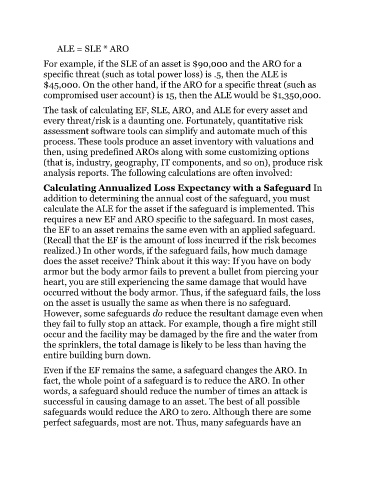
ALE = SLE * ARO

               For example, if the SLE of an asset is $90,000 and the ARO for a
               specific threat (such as total power loss) is .5, then the ALE is

               $45,000. On the other hand, if the ARO for a specific threat (such as
               compromised user account) is 15, then the ALE would be $1,350,000.

               The task of calculating EF, SLE, ARO, and ALE for every asset and
               every threat/risk is a daunting one. Fortunately, quantitative risk
               assessment software tools can simplify and automate much of this
               process. These tools produce an asset inventory with valuations and
               then, using predefined AROs along with some customizing options

               (that is, industry, geography, IT components, and so on), produce risk
               analysis reports. The following calculations are often involved:

               Calculating Annualized Loss Expectancy with a Safeguard In
               addition to determining the annual cost of the safeguard, you must
               calculate the ALE for the asset if the safeguard is implemented. This
               requires a new EF and ARO specific to the safeguard. In most cases,

               the EF to an asset remains the same even with an applied safeguard.
               (Recall that the EF is the amount of loss incurred if the risk becomes
               realized.) In other words, if the safeguard fails, how much damage
               does the asset receive? Think about it this way: If you have on body
               armor but the body armor fails to prevent a bullet from piercing your
               heart, you are still experiencing the same damage that would have

               occurred without the body armor. Thus, if the safeguard fails, the loss
               on the asset is usually the same as when there is no safeguard.
               However, some safeguards do reduce the resultant damage even when
               they fail to fully stop an attack. For example, though a fire might still
               occur and the facility may be damaged by the fire and the water from
               the sprinklers, the total damage is likely to be less than having the
               entire building burn down.


               Even if the EF remains the same, a safeguard changes the ARO. In
               fact, the whole point of a safeguard is to reduce the ARO. In other
               words, a safeguard should reduce the number of times an attack is
               successful in causing damage to an asset. The best of all possible
               safeguards would reduce the ARO to zero. Although there are some
               perfect safeguards, most are not. Thus, many safeguards have an

