


Page 176 - (ISC)² CISSP Certified Information Systems Security Professional Official Study Guide
P. 176
department, division, office, or branch.


               Delphi Technique

               The Delphi technique is probably the only mechanism on the previous
               list that is not immediately recognizable and understood. The Delphi

               technique is simply an anonymous feedback-and-response process
               used to enable a group to reach an anonymous consensus. Its primary
               purpose is to elicit honest and uninfluenced responses from all
               participants. The participants are usually gathered into a single
               meeting room. To each request for feedback, each participant writes

               down their response on paper anonymously. The results are compiled
               and presented to the group for evaluation. The process is repeated
               until a consensus is reached.

               Both the quantitative and qualitative risk analysis mechanisms offer
               useful results. However, each technique involves a unique method of
               evaluating the same set of assets and risks. Prudent due care requires
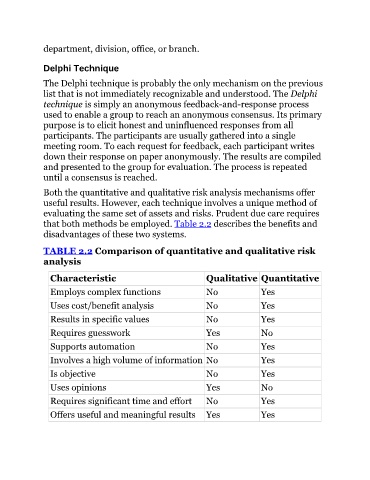
               that both methods be employed. Table 2.2 describes the benefits and

               disadvantages of these two systems.

               TABLE 2.2 Comparison of quantitative and qualitative risk
               analysis


                  Characteristic                                     Qualitative Quantitative
                  Employs complex functions                          No                Yes

                  Uses cost/benefit analysis                         No                Yes

                  Results in specific values                         No                Yes

                  Requires guesswork                                 Yes               No

                  Supports automation                                No                Yes

                  Involves a high volume of information No                             Yes
                  Is objective                                       No                Yes

                  Uses opinions                                      Yes               No

                  Requires significant time and effort               No                Yes

                  Offers useful and meaningful results               Yes               Yes

