


Page 387 - (ISC)² CISSP Certified Information Systems Security Professional Official Study Guide
P. 387
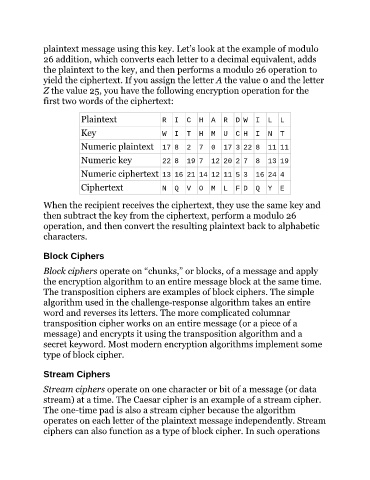
plaintext message using this key. Let’s look at the example of modulo
               26 addition, which converts each letter to a decimal equivalent, adds

               the plaintext to the key, and then performs a modulo 26 operation to
               yield the ciphertext. If you assign the letter A the value 0 and the letter
               Z the value 25, you have the following encryption operation for the
               first two words of the ciphertext:


                            Plaintext                  R   I   C   H   A   R   D W    I   L   L

                            Key                        W   I   T   H   M   U   C H    I   N   T
                            Numeric plaintext          17 8    2   7   0   17 3 22 8      11 11

                            Numeric key                22 8    19 7    12 20 2 7      8   13 19


                            Numeric ciphertext 13 16 21 14 12 11 5 3                  16 24 4
                            Ciphertext                 N   Q   V   O   M   L   F D    Q   Y   E


               When the recipient receives the ciphertext, they use the same key and
               then subtract the key from the ciphertext, perform a modulo 26
               operation, and then convert the resulting plaintext back to alphabetic
               characters.


               Block Ciphers

               Block ciphers operate on “chunks,” or blocks, of a message and apply
               the encryption algorithm to an entire message block at the same time.
               The transposition ciphers are examples of block ciphers. The simple

               algorithm used in the challenge-response algorithm takes an entire
               word and reverses its letters. The more complicated columnar
               transposition cipher works on an entire message (or a piece of a
               message) and encrypts it using the transposition algorithm and a
               secret keyword. Most modern encryption algorithms implement some
               type of block cipher.


               Stream Ciphers


               Stream ciphers operate on one character or bit of a message (or data
               stream) at a time. The Caesar cipher is an example of a stream cipher.
               The one-time pad is also a stream cipher because the algorithm
               operates on each letter of the plaintext message independently. Stream
               ciphers can also function as a type of block cipher. In such operations

