


Page 391 - (ISC)² CISSP Certified Information Systems Security Professional Official Study Guide
P. 391
cryptanalysis techniques and supercomputing power. Modern
               cryptographic systems use at least a 128-bit key to protect data against

               prying eyes. Remember, the length of the key directly relates to the
               work function of the cryptosystem: the longer the key, the harder it is
               to break the cryptosystem.


               Symmetric Key Algorithms

               Symmetric key algorithms rely on a “shared secret” encryption key

               that is distributed to all members who participate in the
               communications. This key is used by all parties to both encrypt and
               decrypt messages, so the sender and the receiver both possess a copy
               of the shared key. The sender encrypts with the shared secret key and
               the receiver decrypts with it. When large-sized keys are used,
               symmetric encryption is very difficult to break. It is primarily
               employed to perform bulk encryption and provides only for the

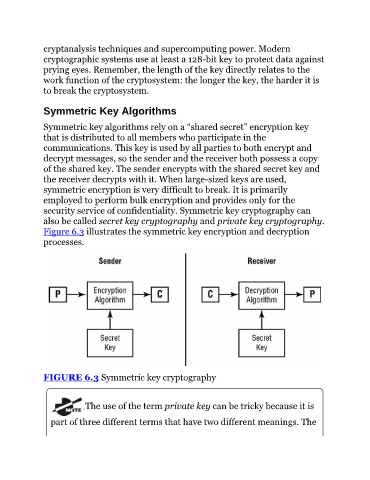
               security service of confidentiality. Symmetric key cryptography can
               also be called secret key cryptography and private key cryptography.
               Figure 6.3 illustrates the symmetric key encryption and decryption
               processes.


               FIGURE 6.3 Symmetric key cryptography


                             The use of the term private key can be tricky because it is

                  part of three different terms that have two different meanings. The

