


Page 394 - (ISC)² CISSP Certified Information Systems Security Professional Official Study Guide
P. 394
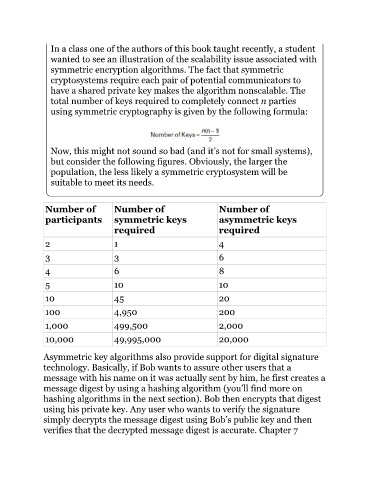
In a class one of the authors of this book taught recently, a student
                  wanted to see an illustration of the scalability issue associated with

                  symmetric encryption algorithms. The fact that symmetric
                  cryptosystems require each pair of potential communicators to
                  have a shared private key makes the algorithm nonscalable. The
                  total number of keys required to completely connect n parties
                  using symmetric cryptography is given by the following formula:


                  Now, this might not sound so bad (and it’s not for small systems),
                  but consider the following figures. Obviously, the larger the

                  population, the less likely a symmetric cryptosystem will be
                  suitable to meet its needs.


                Number of              Number of                         Number of
                participants           symmetric keys                    asymmetric keys

                                       required                          required

                2                      1                                 4
                3                      3                                 6

                4                      6                                 8

                5                      10                                10

                10                     45                                20

                100                    4,950                             200
                1,000                  499,500                           2,000

                10,000                 49,995,000                        20,000


               Asymmetric key algorithms also provide support for digital signature
               technology. Basically, if Bob wants to assure other users that a
               message with his name on it was actually sent by him, he first creates a
               message digest by using a hashing algorithm (you’ll find more on

               hashing algorithms in the next section). Bob then encrypts that digest
               using his private key. Any user who wants to verify the signature
               simply decrypts the message digest using Bob’s public key and then
               verifies that the decrypted message digest is accurate. Chapter 7

