


Page 500 - (ISC)² CISSP Certified Information Systems Security Professional Official Study Guide
P. 500
of access control can be accomplished by storing on each subject a list

               of rights the subject has for every object. This effectively gives each
               user a key ring of accesses and rights to objects within the security
               domain. To remove access to a particular object, every user (subject)
               that has access to it must be individually manipulated. Thus,
               managing access on each user account is much more difficult than
               managing access on each object (in other words, via ACLs).

               Implementing an access control matrix model usually involves the

               following:
                    Constructing an environment that can create and manage lists of

                    subjects and objects

                    Crafting a function that can return the type associated with
                    whatever object is supplied to that function as input (this is
                    important because an object’s type determines what kind of
                    operations may be applied to it)

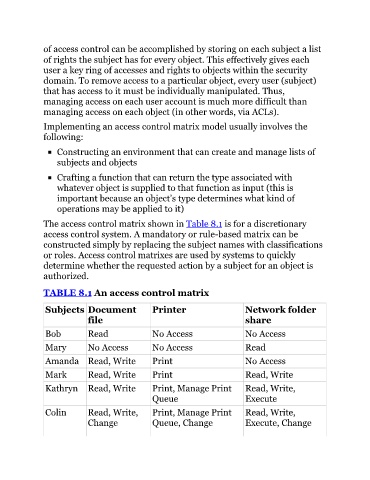
               The access control matrix shown in Table 8.1 is for a discretionary

               access control system. A mandatory or rule-based matrix can be
               constructed simply by replacing the subject names with classifications
               or roles. Access control matrixes are used by systems to quickly
               determine whether the requested action by a subject for an object is
               authorized.


               TABLE 8.1 An access control matrix

                Subjects Document                  Printer                        Network folder
                              file                                                share

                Bob           Read                 No Access                      No Access

                Mary          No Access            No Access                      Read

                Amanda Read, Write                 Print                          No Access
                Mark          Read, Write          Print                          Read, Write

                Kathryn       Read, Write          Print, Manage Print            Read, Write,

                                                   Queue                          Execute
                Colin         Read, Write,         Print, Manage Print            Read, Write,
                              Change               Queue, Change                  Execute, Change

