


Page 503 - (ISC)² CISSP Certified Information Systems Security Professional Official Study Guide
P. 503
These first two properties define the states into which the system can
               transition. No other transitions are allowed. All states accessible

               through these two rules are secure states. Thus, Bell-LaPadula–
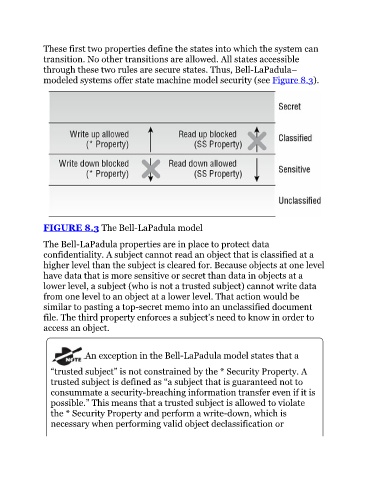
               modeled systems offer state machine model security (see Figure 8.3).


               FIGURE 8.3 The Bell-LaPadula model


               The Bell-LaPadula properties are in place to protect data
               confidentiality. A subject cannot read an object that is classified at a
               higher level than the subject is cleared for. Because objects at one level
               have data that is more sensitive or secret than data in objects at a
               lower level, a subject (who is not a trusted subject) cannot write data
               from one level to an object at a lower level. That action would be
               similar to pasting a top-secret memo into an unclassified document

               file. The third property enforces a subject’s need to know in order to
               access an object.


                             An exception in the Bell-LaPadula model states that a


                  “trusted subject” is not constrained by the * Security Property. A
                  trusted subject is defined as “a subject that is guaranteed not to
                  consummate a security-breaching information transfer even if it is
                  possible.” This means that a trusted subject is allowed to violate
                  the * Security Property and perform a write-down, which is

                  necessary when performing valid object declassification or

