


Page 768 - (ISC)² CISSP Certified Information Systems Security Professional Official Study Guide
P. 768
limiting the use of ICMP or at least limiting its throughput rates. Ping
               of death sends a malformed ping larger than 65,535 bytes (larger than

               the maximum IPv4 packet size) to a computer to attempt to crash it.
               Smurf attacks generate enormous amounts of traffic on a target
               network by spoofing broadcast pings, and ping floods are a basic DoS
               attack relying on consuming all of the bandwidth that a target has
               available.

               You should be aware of several important details regarding ICMP.

               First, the IP header protocol field value for ICMP is 1 (0x01). Second,
               the type field in the ICMP header defines the type or purpose of the
               message contained within the ICMP payload. There are more than 40
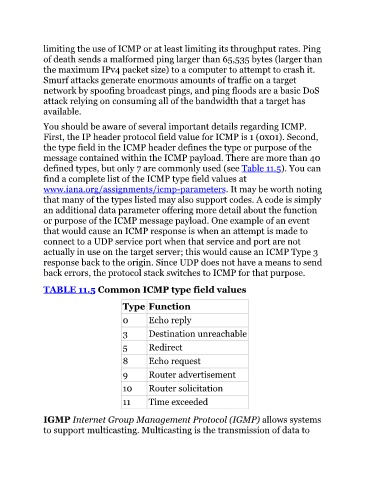
               defined types, but only 7 are commonly used (see Table 11.5). You can
               find a complete list of the ICMP type field values at
               www.iana.org/assignments/icmp-parameters. It may be worth noting
               that many of the types listed may also support codes. A code is simply
               an additional data parameter offering more detail about the function

               or purpose of the ICMP message payload. One example of an event
               that would cause an ICMP response is when an attempt is made to
               connect to a UDP service port when that service and port are not
               actually in use on the target server; this would cause an ICMP Type 3
               response back to the origin. Since UDP does not have a means to send

               back errors, the protocol stack switches to ICMP for that purpose.

               TABLE 11.5 Common ICMP type field values

                                          Type Function

                                          0       Echo reply

                                          3       Destination unreachable

                                          5       Redirect

                                          8       Echo request
                                          9       Router advertisement

                                          10      Router solicitation

                                          11      Time exceeded


               IGMP Internet Group Management Protocol (IGMP) allows systems
               to support multicasting. Multicasting is the transmission of data to

