


Page 763 - (ISC)² CISSP Certified Information Systems Security Professional Official Study Guide
P. 763
what type of packet it is. The IP header’s protocol field indicates the
               identity of the next encapsulated protocol (in other words, the protocol

               contained in the payload from the current protocol layer, such as
               ICMP or IGMP, or the next layer up, such as TCP or UDP). Think of it
               as like the label on a mystery-meat package wrapped in butcher paper
               you pull out of the freezer. Without the label, you would have to open
               it and inspect it to figure out what it was. But with the label, you can
               search or filter quickly to find items of interest. For a list of other
               protocol field values, please visit www.iana.org/assignments/protocol-

               numbers.


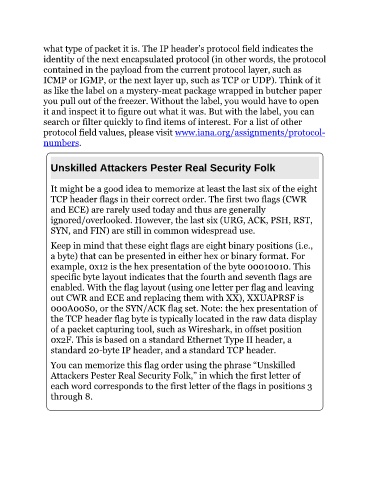
                  Unskilled Attackers Pester Real Security Folk


                  It might be a good idea to memorize at least the last six of the eight
                  TCP header flags in their correct order. The first two flags (CWR
                  and ECE) are rarely used today and thus are generally

                  ignored/overlooked. However, the last six (URG, ACK, PSH, RST,
                  SYN, and FIN) are still in common widespread use.

                  Keep in mind that these eight flags are eight binary positions (i.e.,
                  a byte) that can be presented in either hex or binary format. For
                  example, 0x12 is the hex presentation of the byte 00010010. This
                  specific byte layout indicates that the fourth and seventh flags are
                  enabled. With the flag layout (using one letter per flag and leaving

                  out CWR and ECE and replacing them with XX), XXUAPRSF is
                  000A00S0, or the SYN/ACK flag set. Note: the hex presentation of
                  the TCP header flag byte is typically located in the raw data display
                  of a packet capturing tool, such as Wireshark, in offset position
                  0x2F. This is based on a standard Ethernet Type II header, a
                  standard 20-byte IP header, and a standard TCP header.

                  You can memorize this flag order using the phrase “Unskilled

                  Attackers Pester Real Security Folk,” in which the first letter of
                  each word corresponds to the first letter of the flags in positions 3
                  through 8.

