


Page 766 - (ISC)² CISSP Certified Information Systems Security Professional Official Study Guide
P. 766
administrators the ability to group and then block or allow access

                  to network services, such as file servers or printing.
                  Autoconfiguration removes the need for both Dynamic Host
                  Configuration Protocol (DHCP) and Network Address Translation
                  (NAT). QoS priority values allow for traffic management based on
                  prioritized content.

                  IPv6 is supported by most operating systems released since 2000,
                  either natively or via an add-in. However, IPv6 has been slowly

                  adopted. Most of the IPv6 networks are currently located in private
                  networks such as those in large corporations, research
                  laboratories, and universities. For a glimpse into the status of IPv4
                  to IPv6 conversion on the internet, see the IPv6 statistics at
                  https://www.google.com/intl/en/ipv6/statistics.html.


               IP classes

               Basic knowledge of IP addressing and IP classes is a must for any
               security professional. If you are rusty on addressing, subnetting,
               classes, and other related topics, take the time to refresh yourself.

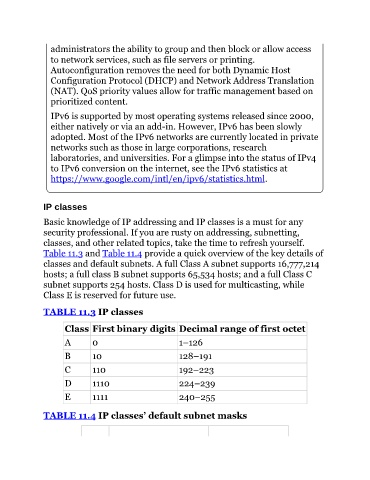
               Table 11.3 and Table 11.4 provide a quick overview of the key details of
               classes and default subnets. A full Class A subnet supports 16,777,214
               hosts; a full class B subnet supports 65,534 hosts; and a full Class C
               subnet supports 254 hosts. Class D is used for multicasting, while
               Class E is reserved for future use.


               TABLE 11.3 IP classes

                      Class First binary digits Decimal range of first octet

                      A         0                           1–126

                      B         10                          128–191

                      C         110                         192–223
                      D         1110                        224–239

                      E         1111                        240–255


               TABLE 11.4 IP classes’ default subnet masks

