


Page 358 - Arte e Historia
P. 358
Danilo De los Santos

by his father, at the same time he attend public school,       despite the mentioned links, becomes stylishly unspeak-
intermediate, secondary and handcraft’s. Here he re-           able. In 1954 opens his third individual showing at the
ceives instruction from notorious masters as Juan Ba-          Fine Arts Gallery critically approached with Jaime Col-
tista Gómez, Federico Izquierdo, Joaquín Priego and            son with whom, conform that year the group «Los Cua-
Mario Villanueva. After his time at the Seminar, he            tro,» including also José Gausachs and Clara Ledesma.
takes a decision to attend Yoryi’s Academy, getting cer-       He achieve Painting First Prize at the 1950’s Biennial and
tificated in 1950. Yoryi’s influence leaves a footprint on     Second Prizes at the 1958’s. At this point is a professor
his first paintings, underlined by his work as a professor     at the Fine Arts National School and a well-known ex-
on his master’s academy. He is transfer to the capital         ponent, nationally and internationally recognized by the
in 1954, to work on the projected Peace Fair. That al-         critics. When he opened his exhibition in Caracas, Ven-
lows him to broaden his skills, now as a house painter,        ezuela, the press writes about him: «In Gilberto Hernán-
helping the Spaniard poster-designer Luis Chavez, wise         dez Ortega all tendencies seem to get mixed. No one, not even
on the tempera’s use, In search of artistic contacts, he       he, is able to frame him on any specific school. Enemy of the
meets Eligio Pichardo, a painter who helps Guillo to           «schools», he strives to make art of his own». («El Nacional,»
orientate himself on the new expressive search, both           October 8th, 1951). The critic José Gómez-Sicre said: «He
linguistic and thematically, like the still life and the       becomes an exponent of the Caribbean art; sensual, imagina-
marine landscape. In 1958, his oil painting «Offshore»         tive, ferocious at times, always profoundly Baroque, trying to
receives a distinction at the IX National Biennial Exhi-       transform an exuberant nature and an indomitable light into a
bition; same year he had his first individual with more        plastic language which, in the same way of the accent we speak
simple focal treatments, really apart from his previous        in our region, would become the common denominator of our
Santiago’s cycle, although the city’s education allow-         geographical origin».
ance marks the emotional tapestry on his speech, now
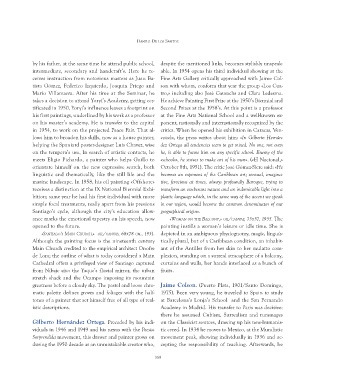
opened to the future.                                              «Woman on the Balcony,» oil/canvas, 73x57, 1955. The
                                                               painting instills a woman’s leisure or idle time. She is
     «Santiago’s Main Church,»  oil/canvas, 68x78 cm., 1951.   depicted in an ambiguous physiognomy, magic, linguis-
Although the painting focus is the nineteenth century          tically plural, but of a Caribbean condition, an inhabit-
Main Church credited to the empirical architect Onofre         ant of the Antilles from her skin to her mulatto com-
de Lora; the outline of what is today considered a Main        plexion, standing on a surreal atmosphere of a balcony,
Cathedral offers a privileged view of Santiago captured        curtains and walls, her hands interlaced as a bunch of
from Nibaje site: the Yaque’s fluvial mirror, the urban        fruits.
stretch shack and the Ocampo imposing its mountain
greatness before a cloudy sky. The pastel and loose chro-      Jaime Colson. (Puerto Plata, 1901/Santo Domingo,
matic palette defines groves and foliages with the half-
tones of a painter that set himself free of all type of real-  1975). Been very young, he traveled to Spain to study
istic descriptions.                                            at Barcelona’s Lonja’s School   and the San Fernando
                                                               Academy in Madrid. His transfer to Paris was decisive:
Gilberto Hernández Ortega. Preceded by his indi-               there he assumed Cubism, Surrealism and rummages
                                                               on the Classicist sources, drawing up his new-humanis-
viduals in 1946 and 1949 and his nexus with the Poesía-        tic creed. In 1934 he moves to Mexico, at the Muralistic
Sorprendida movement, this drawer and painter grows on         movement peak, showing individually in 1936 and ac-
during the 1950 decade as an unmistakable creator who,         cepting the responsibility of teaching. Afterwards, he

359

