


Page 360 - Arte e Historia
P. 360
Danilo De los Santos

School as Colson and Vela Zanetti. The paintings and         CONFLUENCES AND SIGNS FROM
fragment titles refer to the thematic descriptions. The      FOUR GENERATIONS, 1960-1968
execution corresponds to 1951: «Three figures and an Án-
gel,» three panels ensemble,   64x134 cm. «Ninfa,» fragment      There are six painters associated with different gen-
                                                             erations: Yoryi Morel, with his first individual exhibition
60x64 cm. «Faunnus,» fragment 69x57 cm.                      in 1932; Gilberto Hernández Ortega, from the 1940’s
                                                             generation; Ada Balcácer, Guillo Pérez, Plutarco Andú-
Antonio Prats-Ventós. (Barcelona, 1925). He arrives          jar, y Paul Giudicelli, who emerged during the 1950’s
                                                             decade, converged with Cándido Bidó, Leopoldo Pérez
to Dominican Republic with his mother, step father and       (Lepe), José Rincón Mora y Ramón Oviedo, representa-
his younger brother, Ramón. After living for a while in      tives of the1960’s generation.
Las Vegas en 1941, the family resolves to live in the capi-
tal city, in 1942, same year the Fine Arts National School       The 1960’s period constitutes the scene for the dra-
was created. His parents travel to Mexico but he remains     matic course of events involving the June 14th, 1959 mili-
here with his brother. He has been trained by his step       tary invasion against Trujillo, the revolutionary groups in
father, Shum Vila, and takes part with an oil painting       Constanza, Maimón y Estero Hondo; involving people
at the Fine Arts National Gallery Self-portraits Exhibi-     who sacrificed their lives in the fighting, and the indis-
tion, in 1943. He was strongly leaning towards sculpture,    criminate imprisonments carried out by a tyranny close
so he receive training with the woodworker Pascual Pala-     to its end amid an international environment of Carib-
cios, Francisco Dorado and Manolo Pascual. By 1945, he       bean tensions provoked by the triumph of the Cuban
carves any material support like stone and wood; achiev-     revolution (1959). Its communist leaning harmed the
ing the second prize the following year at the III Visual    U.S, geopolitical interests on their strategic zone, the one
Arts Biennial. (1946).                                       that connect the Latin American mainland countries.
                                                             From México, passing by the Central American region
    A group of 40 sculptures is shown at his first indi-     throughout South America; Trujillo’s tentacles conspired
vidual exhibition, in 1947. He was awarded several times     with repulsive outcomes like the attempt to kill President
in different National Biennials from 1948 through  out       Rómulo Betancourt, from Venezuela. This awful ac-
1956, been already a tridimensional art professor at         tion provoked international diplomatic sanctions that
theFine Arts National School, institution in which he        brought about the blockade of the Dominican economy
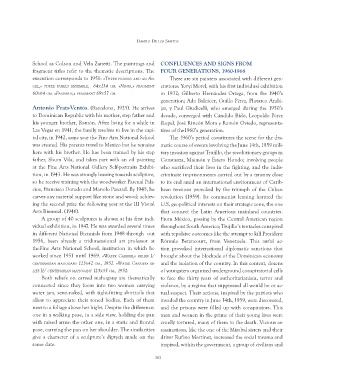
worked since 1951 until 1969. «Water Carrier,» relief I/     and the isolation of the country. In this context, dozens
                                                             of youngsters organized underground conspiratorial cells
centenarian mahogany 123x42 cm., 1952. «Water Carrier» re-   to face the thirty years of authoritarianism, terror and
                                                             violence, by a regime that suppressed all would be or ac-
lief II/ centenarian mahogany 123x35 cm., 1952.              tual suspect. Their actions, inspired by the patriots who
    Both reliefs on carved mahogany are thematically         invaded the country in June 14th, 1959, were discovered,
                                                             and the prisons were filled up with conspirators. This
connected since they focus into two women carrying           men and women in the prime of their young lives were
water jars, semi-naked, with tight-fitting shirttails that   cruelly tortured, many of them to the death. Vicious as-
allow to appreciate their toned bodies. Each of them         sassinations, like the one of the Mirabal sisters and their
next to a foliage above her hight. Despite the difference:   driver Rufino Martínez, increased the social trauma and
one in a walking pose, in a side view, holding the pan       inspired, within the government, a group of civilians and
with raised arms: the other one, in a static and frontal
pose, carrying the pan on her shoulder. The similarities
give a character of a sculpture’s diptych made on the
same date.

                                                             361

