


Page 22 - sarah-simblet_sketch-book-for-the-artist
P. 22
INTRODUCTION22

              Posture and Grip

              T o DRAW WELL, your whole relaxed b o d y should be            correct side: if right-handed, place it on your right, a n d
              involved. In this book we will look at parallels between       look to the left of it at your subject; if left-handed, place
              drawing and music. There are also parallels to dance. You      it on your left, and look to the right. There should be an
              do not have to dance to draw, but you need to understand       open, flowing space between your hand, body, and subject.
              that the expression of a line or mark originates in the body   Placing your easel on the wrong side folds your body
              and flows through the shoulder, arm, and hand to the           against your drawing arm. If seated on a b e n c h easel (a
              fingertips. If your body posture is well balanced and you      donkey), or with your drawing board angled between your
              can move freely, your drawing will reflect this. It will also  lap and a chair, don't sit too close to the paper. If your hand
              reflect discomfort if you are in any way cramped.              twists to maneuver between the paper and your body, your
                                                                             lines will distort. Accelerated perspective also occurs if you
                 How you hold your drawing materials is also important.      look down the surface steeply (see pp. 116-17). Ideally, you
              Examples are shown here, but it should not be forgotten        should be able to look
              that many people make remarkable and striking works            comfortably straight ahead
              drawing with their feet or holding their brush or pencil       at your picture plane.
              in their mouths. If using an upright easel, place it on the

              SPACE TO WORK

              Drawing classes can be cramped
              places, but wherever possible,
              make sure you have enough room
              to back away and view your work.
              Regularly step back 6-9 ft (2-3 m)
              to check your progress. From a
              distance you will spot errors you
              cannot see close up. Turning your
              drawing sideways or upside-own
              will also help reveal what is wrong.

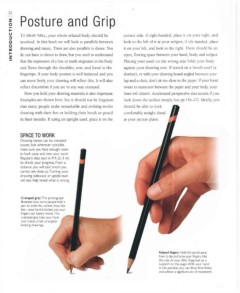
              Cramped grip.This photograph
              illustrates how some people hold a
              pen to write. You cannot draw like
              this—your hand is locked and your
              fingers can barely move. This
              cramped grip tires your hand
              and makes small, strangled-
              looking drawings.

                                                                             Relaxed fingers: Hold the pencil away
                                                                             from its tip and relax your fingers. Use
                                                                             the side of your little fingernail as a
                                                                             support on the page. With your hand
                                                                             in this position, you can draw lines freely
                                                                             and achieve a significant arc of movement.

