


Page 25 - sarah-simblet_sketch-book-for-the-artist
P. 25
Animals

                                 HUMANS HAVE DRAWN ANIMALS from the beginning of our time. After the subject of
                                       ourselves, they are perhaps our favorite pictorial preoccupation. We have drawn

                                 them on the walls of caves to evoke their kinship and power. W e have drawn them in

                                 m a n u s c r i p t s to explain our genesis and to c o u n t their species into Noah's ark. In

                                 medieval England, the Latin bestiary was one of the most popular picture books—an

                                 illustrated dictionary of one hundred parts, each dedicated to the moralized tale of an

                                 animal or monster The bestiary profoundly influenced the art of its period, and we still

                                 see escapees from its pages carved and grinning as the gargoyles of churches, or

                                 scampering through the initials and borders of pictures from that time.

                                 W h e n lost to explain our own emotions, we turn and take the features of beasts.

                                 In 19th-century Europe this became a "science." Paranoid newcomers c r a m m e d into

                                 swelling industrial cities used handbooks of physiognomy to identify and judge their

                                 neighbors. Facial features were analyzed in terms of their animal likeness, from which

                                 personality and predicted behavior were "deduced." Animals perpetually feed our

                                 imaginations. As children we delight in the humanized trials of Tom and Jerry and their

                                 c a r t o o n relations. O v e r the centuries, bats, birds, fish, dogs, and snakes have

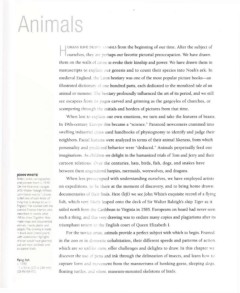
JOHN WHITE                       between them engendered harpies, mermaids, werewolves, and dragons.
  British artist, cartographer,        When less preoccupied with understanding ourselves, we have employed artists

and pioneer born c. 1540.        on expeditions, to be there at the m o m e n t of discovery, and to bring h o m e drawn
On the Roanoke voyages           documentaries of their finds. Here (left) we see J o h n White's exquisite record of a flying
of Sir Walter Raleigh, White's   fish, which very likely leaped o n t o the deck of Sir Walter Raleigh's ship Tiger as it
commission was to "...drawe      sailed north from the Caribbean to Virginia in 1585. Europeans on board had never seen
to lief one of each kinde of     such a thing, and this very drawing was to endure many copies and plagiarisms after its
thing that is strange to us in   triumphant return to the English court of Queen Elizabeth I.
England." He worked with the
scientist Thomas Harriot, who          For the novice artist, animals provide a perfect subject with which to begin. Framed
                                 in the zoo or in domestic cohabitation, their different speeds and patterns of action,
  describedin words what         which are so unlike ours, offer challenges and delights to draw. In this chapter we
   White drew. Together they

made maps and documented
animals, insects, plants, and
 people. This drawing is made
in black lead (metal point)

  with watercolor Highlights
of silver would have gleamed,
out are now oxidized and
so appear black

                                 discover the use of pens and ink through the delineation of insects, and learn how to

Flying Fish                      capture form and movement from the mannerisms of honking geese, sleeping dogs,

        c. 1590

11 x91/4in (277 x 234 mm)

J O H N WHITE                    floating turtles, and silent, m u s e u m - m o u n t e d skeletons of birds.

