


Page 38 - sarah-simblet_sketch-book-for-the-artist
P. 38
ANIMALS38

          Capturing Character

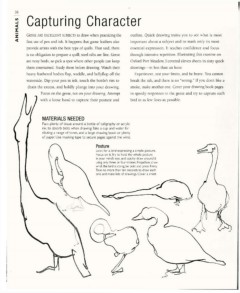
         GEESE ARE EXCELLENT SUBJECTS to draw when practicing the         outline. Quick drawing trains you to see what is most
         first use of pen and ink. It happens that goose feathers also    important about a subject and to mark only its most
         provide artists with the best type of quills. That said, there   essential expression. It teaches confidence and focus
         is no obligation to prepare a quill; steel nibs are fine. Geese  through intensive repetition. Illustrating this exercise on
         are nosy birds, so pick a spot where other people can keep       Oxford Port Meadow, I covered eleven sheets in sixty quick
         them entertained. Study them before drawing. Watch their         drawings—in less than an hour.
         heavy feathered bodies flap, waddle, and bellyflop off the
         waterside. Dip your pen in ink, touch the bottle's rim to            Experiment, test your limits, and be brave. You cannot
          drain the excess, and boldly plunge into your drawing.          break the nib, and there is no "wrong." If you don't like a
                                                                          stroke, make another one. Cover your drawing book pages
                      Focus on the geese, not on your drawing. Attempt    in speedy responses to the geese and try to capture each
                      with a loose hand to capture their posture and      bird in as few lines as possible.

         MATERIALS NEEDED

         Pack plenty of tissue around a bottle of calligraphy or acrylic
         ink, to absorb blots when drawing. Take a cup and water for
         diluting a range of tones, and a large drawing book or plenty
         of paper Use masking tape to secure pages against the wind.

                                             Posture

                                                           Look for a bird expressing a simple posture.
                                                           Focus on it. Try to hold the whole posture
                                                           in your mind's eye, and quickly draw around it
                                                           using only three or four strokes. Empathize, draw
                                                           what the bird is doing, be bold and press firmly,
                                                           Take no more than ten seconds to draw each
                                                           one and make lots of drawings. Cover a sheet.

