


Page 34 - sarah-simblet_sketch-book-for-the-artist
P. 34
ANIMALS34

          Pen and Ink

         W I T H A HANDFUL OF FEATHERS, s t i c k s , a n d m e t a l p o i n t s ,  from the acacia tree, and first used by the Egyptians. The
                                                                                     Chinese used animal or fish glue. The paste from either
         you can have great fun drawing the world around you.                        recipe is pressed and dried into a bar for storage. The bar
         Intricate or dramatic lines, spots, and spatters can be made                is then rubbed into water on a slate block to produce ink.
         with an exotic choice of inks. The Egyptians and Chinese
         are credited with the invention of carbon ink, simultaneously                  Today, high-quality Chinese and Japanese inks are subtler
         4 , 5 0 0 years ago, and it is still in use today. A German                 and more complex than those produced in Europe. Masters
         recipe of 1531 gives a simple description: "Take a wax                      choose brands of long, distinguished manufacture, the recipes
                                                                                     for which have been handed down over centuries. In the Far
                              candle, light it, and hold it under a clean            East, ink is traditionally applied with a brush (see pp.246-47).
                                            basin until the soot hangs to            Dip pens began their history in the Nile River, where reeds
                                             it; then pour a little warm gum         were gathered. Quills were later cut from feathers, while metal
                                               water into it and temper the two      nibs began as rare gifts in gold and silver before being
                                                together. That is an ink." "Gum"     perfected by the British steel industry.
                                                refers to gum arabic extracted

         PENS

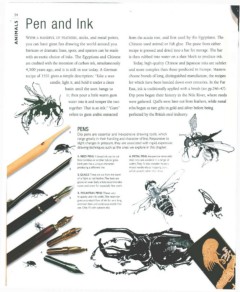
         Dip pens are essential and inexpensive drawing tools, which

         range greatly in their handling and character of line. Responsive to

         slight changes in pressure, they are associated with rapid, expressive

         drawing techniques such as the ones we explore in this chapter

         1. REED PENS: A broad nib can be cut                                        4. METAL PENS: Inexpensive removable
         from bamboo or another tubular grass.                                       steel nibs are available in a range of
         Each pen has a unique character,                                            widths. They fit into wooden holders.
         producing a different line.                                                 Avoid needle-sharp mapping pens,
                                                                                     which scratch rather than draw.
         2. QUILLS: These are cut from the barrel
         of a flight or tail feather. The best are
         goose or swan. Early artists recommended
         raven and crow for especially fine work.

         3. F O U N T A I N PENS: These vary
         in quality and nib width. The reservoir
         gives a constant flow of ink for very long
         unbroken lines and continuous bottle-free
         use. Only fill with suitable inks.

