


Page 70 - sarah-simblet_sketch-book-for-the-artist
P. 70
ARCHITECTURE70

  The Order of Sound
              BOTH OF THESE VISIONARY DRAWINGS o c c u p y a s l e n d e r ,  been a natural affinity between the visual rhythms of
                                                                              pictures and the audible rhythms of music. We can see, and
              upright pictorial space. The architect and musician Daniel      in a sense hear, such a rapport in both of these drawings.
              Libeskind has drawn a stampeding cacophany of airborne          Libeskind begins quietly in the upper space of his drawing,
              architectural detail, while the composer Erik Satie has made    before cascading into a riot of line and sound below. Satie
              an enclosure of quiet order and grace. Both men used rulers     draws quietly throughout, and the spaces between his
              and pens to carefully and slowly construct their compositions.  windows and turrets are the visual equivalent of pauses in

                  Contemporary musicians commonly collaborate with            h i s m u s i c c o m p o s i t i o n s for p i a n o (see also Bussotti, p.223).
              artists by interpreting images as sound. There has always

                                                                              DANIEL LIBESKIND

                                                                              A Polish American architect
                                                                              of international acclaim.
                                                                              Libeskind's numerous
                                                                              commissions include concert
                                                                              halls and museums. He also
                                                                              produces urban and landscape
                                                                              designs, theater sets, installations,
                                                                              and exhibitions of his drawings.
                                                                              Libeskind studied music before
                                                                              transferring to architecture. He
                                                                              also contributed to plans for the
                                                                              rebuilding of the World Trade
                                                                              Center site in New York.

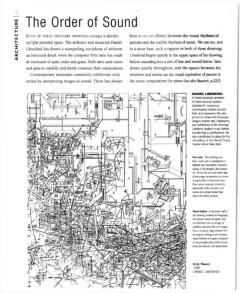
                                                                              Floor plan This drawing has
                                                                              been made with a rapidograph, a

                                                                                refillable pen that feeds a constant
                                                                              supply of ink through a fine tubular
                                                                              nib. Across the top and center right
                                                                              of the image w e perceive an almost
                                                                              recognizable architectural plan.
                                                                              Floor space appears divided by
                                                                              discernible walls, corridors, and
                                                                              rooms, and arched dotted lines
                                                                              depict the radius of doors.

                                                                              Visual rhythms In the lower half of
                                                                              this drawing architectural language
                                                                              has broken loose: escaped and
                                                                              transformed into an image of
                                                                              rebellious pleasure. We can imagine
                                                                              how a musician might interpret this
                                                                              drawing by looking at the abstract
                                                                              visual rhythms of masses composed
                                                                              of long straight poles, short curved
                                                                              poles, flat boards, and dotted lines.

                                                                              Arctic Flowers
                                                                              1980
                                                                              DANIEL LIBESKIND

