


Page 96 - sarah-simblet_sketch-book-for-the-artist
P. 96
OBJECTS AND INSTRUMENTS96

   Light and Illusions

                         SEEING IS MIRACULOUS. U p s i d e - d o w n patterns of light on     The outermost edge of our vision, less developed than the
                         our retinas, transmitted to the brain as chains of electrical        center, reads only movement and can often make mistakes.
                         impulses, are translated into a world of space, atmosphere,          Someone passes our open door, perhaps; we turn our head
                         form, and movement. To interpret visual stimulus, our                but no one was there. The slightest recognition is instantly
                         brains search for nameable things, and are quick to                  matched to our wealth of experience and expectation, and
                         propose ideas. We will even see things that do not exist             we can be fooled. Here we look briefly at our perception of
                         because minimal information suggests they are likely to be           light and darkness and our interpretation of diagrammatic
                         there. We only need small prompts; hence our recognition             illusions. Through these we can enjoy witnessing our own
                         of a cartoon face composed of three lines, and our ability           deception and bafflement and understand certain factors
                         to see forms in clouds or fire.                                      that are very useful in picture-making.

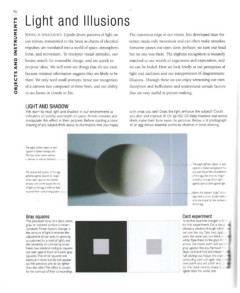
                         LIGHT AND SHADOW                                                     with what you see? Does the light enhance the subject? Could
                                                                                              you alter and improve it? On pp.102-03 deep shadows cast across
                         W e learn to read light and shadow in our environment as             shells make their form easier to perceive. Below, a lit photograph
                         indicators of solidity and depth of space. Artists emulate and       of an egg shows essential points to observe in tonal drawing.
                         manipulate this effect in their pictures. Before starting a tonal
                         drawing of any subject, think about its illumination. Are you happy

                         The egg's darkest region is seen                                                  The egg's lightest region is seen
                         against a lighter background.                                                     against a darker background. Run
                         The two tones meet without                                                        your eye around the circumference
                         a division or outline between.                                                    of the egg. See how its "edge"
                                                                                                           smoothly changes from light
                         The bottom-left quarter of the egg                                                against dark to dark against light.
                         lightens slightly toward its "edge"
                         when seen against the darker                                                      Below the bottom "edge" of the
                         shadow cast on the paper. The rim                                                 egg there is a rim of light reflected
                         of light on the egg is reflected light                                            onto the paper by the underside
                         received from surrounding paper.                                                  of the egg.

                         Gray squares                                                         Card experiment

                         The perceived tone of a black white,                                 To further examine changes in tone,
                         gray, or colored surface is never                                    try this experiment. On acloudyday,
                         constant. Three factors change it:
                         the amount of light it receives; the                                                                                   cho
                         adjustment of our eyes (in growing                                                                                     can
                         accustomed to a level of light); and                                 cards the same size, one blackandone
                         the proximity of contrasting tones.                                  white. Tape them to the glass. From
                         Here, two identical mid-gray squares                                 across the room both will appear
                         are seen against black and paler gray                                                                                  gra
                         squares. The small squares are                                       black card and fold and retapeitwith
                         identical in tone, but do not appear                                 half sticking out. Adjust the angleofthe
                         so. We perceive one to be lighter                                    protruding part and again stepback.At
                         than theother.This effect is caused                                  one point you will catchenoughlight
                         by the contrast of their surroundings.                                                                                 on
                                                                                              lighter than the white one.

