


Page 100 - sarah-simblet_sketch-book-for-the-artist
P. 100
OBJECTS AND INSTRUMENTS100 How to Draw Ellipses
                         W E VISUALIZE CYLINDRICAL VESSELS, such as bowls and cups,       of seeing. Cubism, for example, (see p.90) takes a different
                         as essentially circular, since this is how we experience them    view, describing many sides of an object simultaneously.
                         in everyday use. However, when seen at an angle, circles
                         change into ellipses, and these narrow or widen depending            Ellipse are best d r a w n quickly, smoothly, a n d in o n e
                         on the height of our view. To make a cylindrical object appear   bold stroke, even if y o u r hand w o b b l e s a little at first. A
                         real in our pictorial space, we use ellipses to give a sense of  wobbling but confident ellipse will still be more convincing
                         perspective. Be aware, though, that this is only one w a y       than a slow, hesitant one that has edged its way nervously
                                                                                          around the vessel's rim.

                         COMMON ERRORS

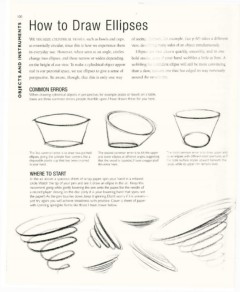
                         W h e n drawing cylindrical objects in perspective, for example plates or bowls on a table,
                         there are three common errors people stumble upon. I have drawn these for you here.

                         The first common error is to draw two pointed       The second common error is to tilt the upper             third common error is to draw upper and
                         ellipses, giving the cylinder four corners, like a  and lower ellipses at different angles, suggesting  lover ellipses with different-sized apertures, as if
                         disposable plastic cup that has been crushed        that the vessel is lopsided. I have exaggerated     the table surface slopes upward beneath the
                         in your hand.                                       this error here.                                     vessel, while its upper rim remains level.

                         WHERE TO START

                         In the air above a spacious sheet of scrap paper; spin your hand in a relaxed
                         circle. Watch the tip of your pen and see it draw an ellipse in the air Keep this
                         movement going while gently lowering the pen onto the paper like the needle of
                         a record player closing on the disc (only it is your lowering hand that spins, not
                         the paper!) As the pen touches down, keep it spinning. Don't worry if it is uneven—
                         just try again; you will achieve steadiness with practice. Cover a sheet of paper
                         with spinning, springlike forms like those I have drawn below.

