


Page 99 - sarah-simblet_sketch-book-for-the-artist
P. 99
99

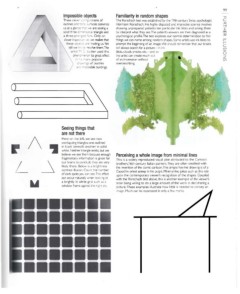
Impossible objects                                          Familiarity in random shapes                                                                               FURTHER ILLUSIONS

These clever configurations of                              The Rorschach test was established by the 19th-century Swiss psychologist
outlines and tonal surfaces convince                        Hermann Rorschach. His highly disputed and imprecise science involves
us at a glance that we are seeing a                         showing unprepared patients ten particular ink blots and asking them
solid three-dimensional triangle and                        t o i n t e r p r e t w h a t t h e y see. T h e patient's answers are t h e n diagnosed as a
a three-pronged fork. O n l y o n                           psychological profile. T h e t e s t e x p l o r e s o u r n o r m a l d e t e r m i n a t i o n t o find
 closer inspection we realize that                          things w e can name among random shapes. Some artists use ink blots t o
                                                            prompt the beginning of an image. W e should remember that our brains
   t h e s e o b j e c t s are fooling us. Yet              will always search for a picture—in ink
      still w e try resolve t h e m . T h e                 blots, clouds, smoke, etc.—and so
        artist M. C Escher used this                        the artist can create much out
                                                            of an impression without
phenomenon t o great effect                                 overdescribing.
             in his many p o p u l a r
               drawings of puzzles
              and impossible buildings.

Seeing things that                                          Perceiving a whole image from minimal lines

are not there                                               This is a w i d e l y r e p r o d u c e d visual j o k e a t t r i b u t e d t o t h e Carracci
                                                            brothers,16th-century Italian painters. They are often credited with
Here on the left, w e see t w o                             t h e invention o f t h e c o m i c c a r t o o n . This simple five-line d r a w i n g is o f a
overlapping triangles: one outlined                         Capuchin priest asleep in his pulpit. Minimal-line jokes such as this rely
in black beneath a n o t h e r in solid                     upon the contemporary viewer's recognition of the shapes. Coupled
white. Neither triangle exists, but w e                     w i t h t h e Rorschach b l o t above, this is a n o t h e r e x a m p l e o f t h e viewer's
believe w e see them because enough                         brain being willing t o d o a large a m o u n t o f the w o r k in deciphering a
f r a g m e n t a r y i n f o r m a t i o n is given f o r  p i c t u r e . T h e s e e x a m p l e s illustrate h o w little is n e e d e d t o c o n v e y an
our brains to conclude they are very                        image. Much can be expressed in only a few marks.
likely t h e r e . B e l o w is a brightness
contrast illusion. Count the number
of dark spots you can see. This effect
can occur naturally when looking at
a brightly lit w h i t e g r i d such as a
w i n d o w f r a m e against t h e night sky.

