


Page 19 - TEST1
P. 19
TSCampaign                                                                                         TSCampaign
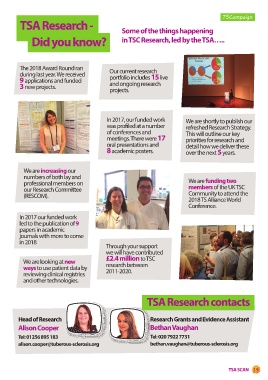
          TSA Research -
 Landmark decision as everolimus for  Did you know?        Some of the things happening
                                                       in TSC Research, led by the TS A…..
 refractory epilepsy in people with


 TSC is accepted for use in Scotland  The 2018 Award Round ran


          during last year. We received           Our current research
                                                  portfolio includes 15live
          9applications and funded
 As the everolimus debate continues for TSC patients,  3new projects.  and ongoing research
                                                  projects.
 the TSA is making sure your voices are being heard

 We are delighted to tell you that the Scottish Medicines Consortium
 (SMC) announced on Monday June 11 that everolimus will be available
 on prescription to treat TSC related refractory epilepsy in people aged  In 2017, our funded work  We are shortly to publish our
 two years and older with Tuberous Sclerosis Complex (TSC) in Scotland.   was profiled at a number  refreshed Research Strategy.
                                                of conferences and
 Our CEO Maxine Smeaton said: “We are absolutely delighted with this announcement. This  meetings. There were 17  This will outline our key
 decision will have a tremendous impact on the physical and mental health of people living with TSC-related refractory  priorities for research and
 epilepsy in Scotland, as well as improving the quality of life for their families and carers.”  oral presentations and   detail how we deliver these
                                                8academic posters.
 Maxine added: “We are grateful to SMC for providing the TSA with the opportunity to speak  over the next 5years.
 directly to the decision-making panel along with our patient representative, Craig Ireland. His
 first hand experience was key to helping the SMC make an informed decision about the
 benefits of taking everolimus for TSC related refactory epilepsy.” Father-of-one Craig, from  We are increasingour
 Falkirk, represented Scotland’s TSC community at an SMC hearing in Glasgow last month.   numbers of both lay and  We are funding two
            professional members on
 Dr Chris Kingswood, TSA Trustee stated: “This is fantastic news and a game-changing  our Research Committee  members of the UK TSC
 landmark in the treatment of TSC. The TSA will now develop a plan to support the NHS to  (RESCOM).  Community to attend the
 Craig Ireland                                                                       2018 TS Alliance World
 ensure all patients who need everolimus, have access and can be safely monitored.”
 Dr Kingswood is a consultant nephrologist who chairs the TSC’s research committee. Jill Booth, Area Drug and  Conference.
 Therapeutics Committees Clinical Adviser for the Scottish Medicines Consortium, said: “We would like to thank the TSA  In 2017 our funded work
 for the time and effort taken to produce your submission and also for your participation in the PACE (Patient and clinical  led to the publication of 9
 engagement) process. Capturing the views and experiences of patients and carers is an important part of the SMC  papers in academic
 process and plays a key role in helping our committee reach its decisions. We hope that your patient group will  journals with more to come
 welcome this decision.” The TSA is also contributing to work underway by NHS England in a bid to secure everolimus  in 2018
 available on prescription for people with TSC related refractory epilepsy in England. A decision by NHS England’s Clinical  Through your support
 Priorities Advisory Group (CPAG) is expected in the next few weeks. “We are looking forward to what we hope will be a  we will have contributed
 similarly positive decision about everolimus by NHS England,” said Maxine Smeaton.  We are looking at new  £2.4 millionto TSC
           waysto use patient data by           research between
                                                2011-2020.
           reviewing clinical registries
 How does the CPAG work?  and other technologies.

 The CPAG makes recommendations on NHS England’s approach to commissioning
 services, treatments and technologies, and considers which of these should be
 prioritised for investment. Its scope includes all specialised services provided by NHS  TSA Research contacts
 England. The advisory group assesses drugs, medical devices and treatments
 according to their clinical effectiveness, benefit for patients and value for money.
 It considers recommendations from clinical reference groups (CRGs)   Head of Research   Research Grants and Evidence Assistant
 and teams covering NHS England’s specialised commissioning   Alison Cooper  Bethan Vaughan
 James Palmer, Medical Director for
 responsibilities and takes into account detailed information
 Specialised Services, NHS England  Tel: 01256 895 183              Tel: 020 7922 7731
 about the financial impact.
         alison.cooper@tuberous-sclerosis.org                       bethan.vaughan@tuberous-sclerosis.org
 To find out more about the CPAG process watch this video youtu.be/b1exxrBDUEU


 18 Summer 2018                                                                                        TSA SCAN   19

