


Page 17 - PESY Vol 7 No 4
P. 17
PESY: Print ISSN 2231-1394, Online ISSN 2278-795X                                                                    Vol. 7 No 4


                    METHODOLOGY
                          For  the  purpose  of  study,  four  teams  from  different  regions  of  University  Cricket
                    (Women) players were selected at random. Since the data pertains to the team players, the
                    numbers of subjects were limited to the team. The players were approached a day prior to the
                    competition to administer the “Competition Anxiety test”.
                          The   SCAT  (according    to   Martens,   1990)   –    is   an  analysis   of   Competition
                    anxiety; a test measuring the tendency of an athlete to experience anxiety when competing in
                    a sport. It is used to measure competitive trait anxiety. Test scoring is based on 10 questions
                    that  ask  individuals  how  they  feel  when  competing  in  sports  and  games.  Each  item  is
                    answered on a three-point scale (often, sometimes, hardly ever) and a summary score ranging
                    from 10 (low competitive trait anxiety) to 30 (high competitive trait anxiety) is computed for
                    each respondent. SCAT score is obtained based on the guide for the test.
                          To  examine  the  hypothesis  study,  descriptive  statistics  such  as  mean,  standard
                    deviation, variation and comparative statistics – one –way ANOVA were used.
                    The data was analysed using the Microsoft Data Analysis package of Anova-one-way.

                    DATA      COLLECTION         –    INTER-UNIVERSITY         CRICKET        (WOMEN)
                    COMPETITION
                          Researcher has personally contacted the respective teams chosen as subjects of study.
                    Sport competition anxiety test (SCAT)questionnaire was used for collection of response of
                    players.
                          16  players  were  chosen  at  random  from  each  team.  A  total  of  64  players  were
                    administered  the  SCAT  questionnaire.  Consent,  along  with  demographic  information  was
                    obtained from each subject player before administering the questionnaire.
                          The  players  were  briefed  regarding  the  purpose  of  the  study  and  where  required
                    explained the questions where they had doubts due to language. No assistance, however, was
                    directed towards any specific response. The data was restricted to the players only. The data
                    was collected separately from the teams ensuring that there was no sharing of response by the
                    players  from  different  teams.The  SCAT  questionnaire  was  administered  and  the  response
                    obtained from the teams. The data was compiled. Scores were obtained using the reference
                    keys. The results were used for statistical analysis.

                    DATA ANALYSIS
                          The  basic  statistical  parameters  of  arithmetic  mean,  standard  deviation  (SD),
                    maximum and minimum values and variance were processed. Differences between the groups
                    for  assessing  the  anxiety  levels  amongst  cricket  players  was  determined  using  one-way
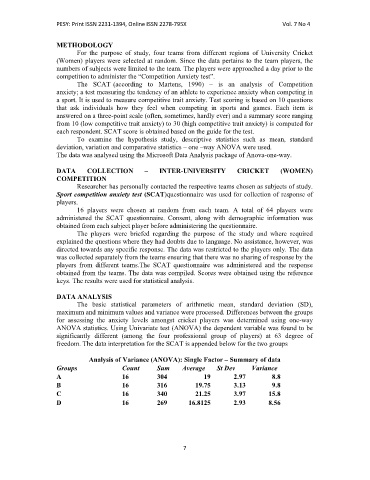
                    ANOVA statistics. Using Univariate test (ANOVA) the dependent variable was found to be
                    significantly  different  (among  the  four  professional  group  of  players)  at  63  degree  of
                    freedom. The data interpretation for the SCAT is appended below for the two groups

                              Analysis of Variance (ANOVA): Single Factor – Summary of data
                    Groups               Count       Sum     Average     St Dev     Variance
                    A                    16          304            19        2.97         8.8
                    B                    16          316          19.75       3.13         9.8
                    C                    16          340          21.25       3.97        15.8
                    D                    16          269       16.8125        2.93        8.56


                                                              7

