


Page 18 - PESY Vol 7 No 4
P. 18
PESY: Print ISSN 2231-1394, Online ISSN 2278-795X                                                                    Vol. 7 No 4


                    ANOVA
                    Source of Variation      SS        df       MS           F       P-value      F crit
                      Between Groups      163.9219      3     54.6406     5.0873      0.0033     2.7581
                      Within Groups       644.4375     60     10.7406
                           Total          808.3594     63

                                                        SCAT Scores

                         30
                         28
                         26
                         24
                         22
                         20
                         18
                         16
                         14
                         12
                         10
                              1   2    3   4    5   6    7   8    9  10   11  12   13  14   15  16

                                                      A      B     C     D


                    FINDINGS
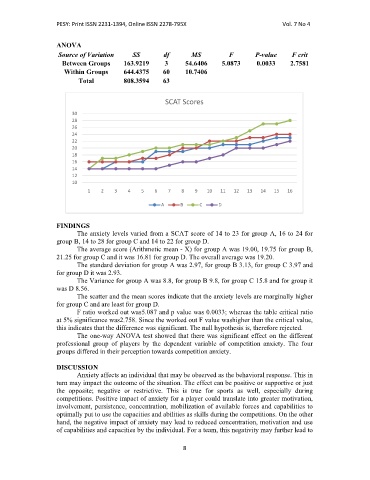
                          The anxiety levels varied from a SCAT score of 14 to 23 for group A, 16 to 24 for
                    group B, 14 to 28 for group C and 14 to 22 for group D.
                          The average score (Arithmetic mean - X) for group A was 19.00, 19.75 for group B,
                    21.25 for group C and it was 16.81 for group D. The overall average was 19.20.
                          The standard deviation for group A was 2.97, for group B 3.13, for group C 3.97 and
                    for group D it was 2.93.
                          The Variance for group A was 8.8, for group B 9.8, for group C 15.8 and for group it
                    was D 8.56.
                          The scatter and the mean scores indicate that the anxiety levels are marginally higher
                    for group C and are least for group D.
                          F ratio worked out was5.087 and p value was 0.0033; whereas the table critical ratio
                    at 5% significance was2.758. Since the worked out F value washigher than the critical value,
                    this indicates that the difference was significant. The null hypothesis is, therefore rejected.
                          The one-way ANOVA test showed that there was significant effect on the different
                    professional  group  of  players  by  the  dependent  variable  of  competition  anxiety.  The  four
                    groups differed in their perception towards competition anxiety.

                    DISCUSSION
                          Anxiety affects an individual that may be observed as the behavioral response. This in
                    turn may impact the outcome of the situation. The effect can be positive or supportive or just
                    the  opposite;  negative  or  restrictive.  This  is  true  for  sports  as  well,  especially  during
                    competitions. Positive impact of anxiety for a player could translate into greater motivation,
                    involvement, persistence, concentration, mobilization of available forces and capabilities to
                    optimally put to use the capacities and abilities as skills during the competitions. On the other
                    hand, the negative impact of anxiety may lead to reduced concentration, motivation and use
                    of capabilities and capacities by the individual. For a team, this negativity may further lead to


                                                              8

