


Page 12 - REPOWER REFERENCE GUIDE (2020)
P. 12
Important Information
        Use of Reformulated Fuel: Alcohol in Fuel Recommendations

        Overview
           The use of alcohol in gasoline is increasing as an alternative to strictly petroleum‑based fuel. Alcohol can be found in the
           reformulated oxygenated fuels that are required by the Environmental Protection Agency (EPA) in some areas of the USA. With
           the increased use of alcohol in fuel—either ethanol (ethyl alcohol) or methanol (methyl alcohol)—you should be aware of
           certain adverse affects that can occur. As the percentage of alcohol increases, the degree and possibility of adverse affects
           also increases.
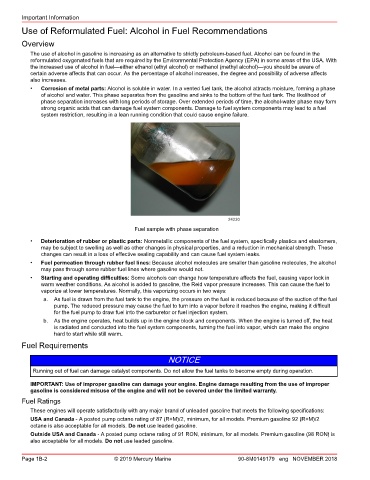
           •   Corrosion of metal parts: Alcohol is soluble in water. In a vented fuel tank, the alcohol attracts moisture, forming a phase
               of alcohol and water. This phase separates from the gasoline and sinks to the bottom of the fuel tank. The likelihood of
               phase separation increases with long periods of storage. Over extended periods of time, the alcohol‑water phase may form
               strong organic acids that can damage fuel system components. Damage to fuel system components may lead to a fuel
               system restriction, resulting in a lean running condition that could cause engine failure.


                                                                            24230
                                              Fuel sample with phase separation

           •   Deterioration of rubber or plastic parts: Nonmetallic components of the fuel system, specifically plastics and elastomers,
               may be subject to swelling as well as other changes in physical properties, and a reduction in mechanical strength. These
               changes can result in a loss of effective sealing capability and can cause fuel system leaks.
           •   Fuel permeation through rubber fuel lines: Because alcohol molecules are smaller than gasoline molecules, the alcohol
               may pass through some rubber fuel lines where gasoline would not.
           •   Starting and operating difficulties: Some alcohols can change how temperature affects the fuel, causing vapor lock in
               warm weather conditions. As alcohol is added to gasoline, the Reid vapor pressure increases. This can cause the fuel to
               vaporize at lower temperatures. Normally, this vaporizing occurs in two ways:
               a.  As fuel is drawn from the fuel tank to the engine, the pressure on the fuel is reduced because of the suction of the fuel
                   pump. The reduced pressure may cause the fuel to turn into a vapor before it reaches the engine, making it difficult
                   for the fuel pump to draw fuel into the carburetor or fuel injection system.
               b.  As the engine operates, heat builds up in the engine block and components. When the engine is turned off, the heat
                   is radiated and conducted into the fuel system components, turning the fuel into vapor, which can make the engine
                   hard to start while still warm.
        Fuel Requirements

                                                         NOTICE

            Running out of fuel can damage catalyst components. Do not allow the fuel tanks to become empty during operation.

           IMPORTANT: Use of improper gasoline can damage your engine. Engine damage resulting from the use of improper
           gasoline is considered misuse of the engine and will not be covered under the limited warranty.
        Fuel Ratings
           These engines will operate satisfactorily with any major brand of unleaded gasoline that meets the following specifications:
           USA and Canada ‑ A posted pump octane rating of 87 (R+M)/2, minimum, for all models. Premium gasoline 92 (R+M)/2
           octane is also acceptable for all models. Do not use leaded gasoline.
           Outside USA and Canada ‑ A posted pump octane rating of 91 RON, minimum, for all models. Premium gasoline (98 RON) is
           also acceptable for all models. Do not use leaded gasoline.


        Page 1B-2                      © 2019 Mercury Marine                    90-8M0149179 eng NOVEMBER 2018

