


Page 114 - Science Class 6 Times Publication
P. 114
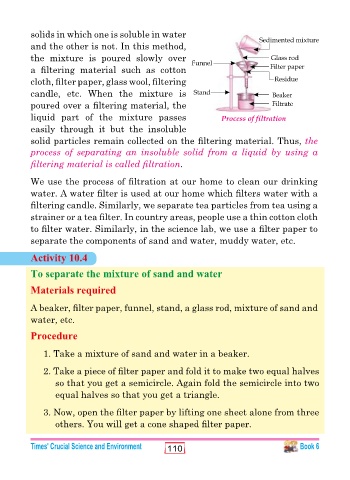
solids in which one is soluble in water
and the other is not. In this method,
the mixture is poured slowly over
a ltering material such as cotton
cloth, lter paper, glass wool, ltering
candle, etc. When the mixture is
poured over a ltering material, the
liquid part of the mixture passes
easily through it but the insoluble
solid particles remain collected on the ltering material. Thus, the
process of separating an insoluble solid from a liquid by using a
ltering material is called ltration.
We use the process of ltration at our home to clean our drinking
water. A water lter is used at our home which lters water with a
ltering candle. Similarly, we separate tea particles from tea using a
strainer or a tea lter. In country areas, people use a thin cotton cloth
to lter water. Similarly, in the science lab, we use a lter paper to
separate the components of sand and water, muddy water, etc.
Activity 10.4
To separate the mixture of sand and water
Materials required
A beaker, lter paper, funnel, stand, a glass rod, mixture of sand and
water, etc.
Procedure
1. Take a mixture of sand and water in a beaker.
2. Take a piece of lter paper and fold it to make two equal halves
so that you get a semicircle. Again fold the semicircle into two
equal halves so that you get a triangle.
3. Now, open the lter paper by lifting one sheet alone from three
others. You will get a cone shaped lter paper.
Times' Crucial Science and Environment 110 Book 6

