


Page 426 - Math Smart - 7
P. 426
CHAPTER 18.2
           In this chapter

       Pupils should be able to:
       •     Identify all the possible
           mutually exclusive
           outcomes of a single
           event


                                                     Calculating probability


                                     Outcomes which give an event that you are Interested
                                     In are called favourable outcomes for that event.
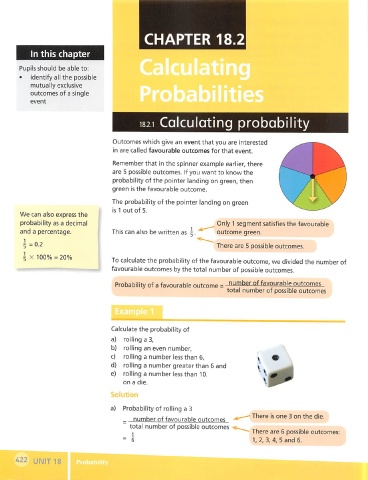
                                     Remember that In the spinner example earlier, there
                                     are 5 possible outcomes. If you want to know the
                                     probability of the pointer landing on green, then
                                     green is the favourable outcome.
                                     The probability of the pointer landing on green
                                     Is 1 out of 5.
       We can also express the
        probability as a decimal                                       Only 1 segment satisfies the favourable
       and a percentage.             This can also be written as 5.    outcome green.

        1=0.2                                                          There are 5 possible outcomes.
        ^ X 100% = 20%
                                     To calculate the probability of the favourable outcome, we divided the number of
                                     favourable outcomes by the total number of possible outcomes.

                                      Probability of a favourable outcome = '^^"^ber of favourable outcomes
                                                                          total number of possible outcomes


                                     Calculate the probability of
                                     a)  rolling a 3,
                                     b)  rolling an even number,
                                     c)  rolling a number less than 6,
                                     d)  rolling a number greater than 6 and
                                     e)  rolling a number less than 10.
                                         on a die.

                                     Solution
                                     a) Probability of rolling a 3
                                                                                   There Is one 3 on the die.
                                         _   number of favourable outcomes
                                           total number of possible outcomes
                                                                                  There are 6 possible outcomes:
                                           1
                                        - 6                                        1, 2, 3, 4, 5 and 6.

                      if*
      422 UNIT 18!,       Probability
                                                                                                                 T|

