


Page 421 - Math Smart - 7
P. 421
CHAPTER 18.1

                                                                                            In this chapter
                                                           bability                     Pupils should be able to:

                                                                                        • use the language of
                            \  'FBr
                                                                                           probability to describe
       What are your chances?                                                              and interpret results
                                                                                           involving likelihood and
                                                                                           chance
                                                                                        • understand and use the
                                                                                           probability scale from
                                                                                           Oto 1
       If you do not buy a ticket,  If you enter a raffle where  If you enter a raffle where
                                                                                        • find probabilities
       you have NO CHANCE of      there are only two tickets,  there are many tickets,     based on equally likely
       winning a prize in the     you have a 50/50 chance    you are UNLIKELY to win       outcomes in simple
       raffle.                    of winning a prize.        a prize.                      contexts


               Using likelihood and chance
                                                                                       ^ RECALL
              to describe probability

                                                                                        Describe the likelihood of
                                                                                        each of these events as
                                                   Q          hink and Share            certain, impossible, likely,

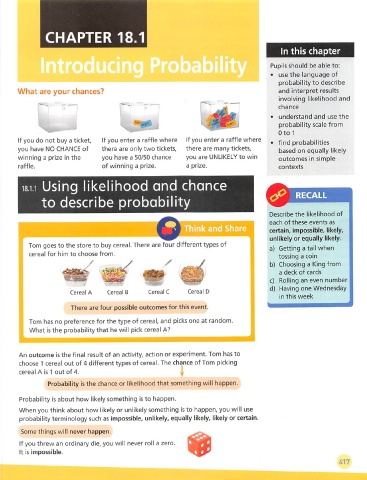
          Tom goes to the store to buy cereal. There are four different types of        unlikely or equally likely.
                                                                                        a) Getting a tail when
          cereal for him to choose from.                                                   tossing a coin

                              /           /          /                                  b) Choosing a King from
                                                                                           a deck of cards
                                               m                                        c) Rolling an even number
                                                                                        d) Having one Wednesday
                        Cereal A    Cereal B     Cereal C     Cereal D
                                                                                           in this week
                        There are four possible outcomes for this event.
          Tom has no preference for the type of cereal, and picks one at random.
          What is the probability that he will pick cereal A?


       An outcome is the final result of an activity, action or experiment. Tom has to
       choose 1 cereal out of 4 different types of cereal. The chance of Tom picking
       cereal A is 1 out of 4.                      |

                Probability is the chance or likelihood that something will happen.

       Probability is about how likely something is to happen.
       When you think about how likely or unlikely something is to happen, you will use
       probability terminology such as impossible, unlikely, equally likely, likely or certain.

        Some things will never happen.
       If you threw an ordinary die, you will never roll a zero.
       It is impossible.
                                                                                                               417

