


Page 431 - Math Smart - 7
P. 431
CHAPTER 18.3                                                              in this chapter

                                                                                        Pupils should be able to:

                                                                                        • compare experimental
                                                                                            and theoretical
                                                                                            probabilities in simple
                                                                                            contexts
                                                                                        •    use experimental
                                                                                            data to estimate
                                                                                            probabilities
        183.1 Theoretical probability


        Recall that probabilities we have calculated earlier are based on equally likely  ^ RECALL
        outcomes. They are theoretical probabilities.
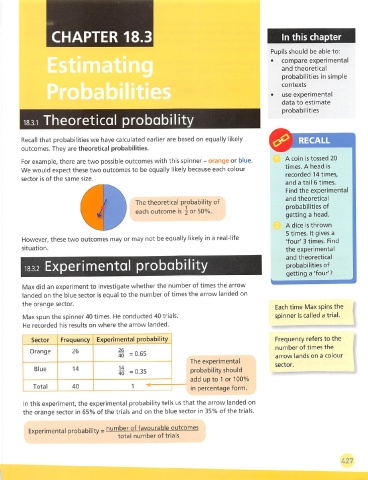
        For example, there are two possible outcomes with this spinner - orange or blue.     A coin is tossed 20
                                                                                             times. A head is
        We would expect these two outcomes to be equally likely because each colour
                                                                                             recorded 14 times,
        sector is of the same size.
                                                                                             and a tail 6 times.
                                                                                             Find the experimental
                                                                                             and theoretical
                                             The theoretical probability of
                                                                                             probabilities of
                                             each outcome is 5 or 50%.
                                                                                             getting a head.
                                                                                             A dice is thrown
                                                                                             5 times. It gives a
        However, these two outcomes may or may not be equally likely in a real-life
                                                                                             'four' 3 times. Find
        situation.                                                                           the experimental
                                                                                             and theorectical
         18.3.2  Experimental probability                                                     probabilities of
                                                                                              getting a 'four'?
        Max did an experiment to investigate whether the number of times the arrow
        landed on the blue sector is equal to the number of times the arrow landed on
        the orange sector.
                                                                                          Each time Max spins the
        Max spun the spinner 40 times. He conducted 40 trials.                            spinner is called a trial.
        He recorded his results on where the arrow landed.

           Sector    Frequency Experimental probability                                   Frequency refers to the
                                                                                          number of times the
           Orange       26
                                       i =0.65                                            arrow lands on a colour
                                                              The experimental
                                                                                          sector.
            Blue        14             ^ =0.35                 probability should
                                                               add up to 1 or 100%
            Total       40                  1      *           in percentage form.

        In this experiment, the experimental probability tells us that the arrow landed on
        the orange sector in 65% of the trials and on the blue sector in 35% of the trials.

          Experimental probability = nomber of favourable outcomes
                                       total number of trials


                                                                                                               427

