


Page 68 - Elementary Algebra Exercise Book I
P. 68
ELEMENTARY ALGEBRA EXERCISE BOOK I equAtions
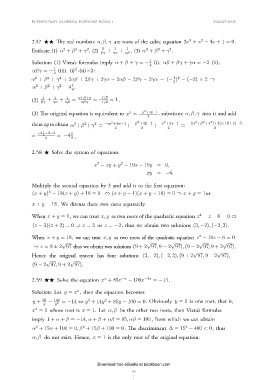
2.57 The real numbers α,β,γ are roots of the cubic equation 2x + x − 4x +1 = 0.
2
3
1
1
1
Evaluate (1) α + β + γ , (2) βγ + γα + αβ , (3) α + β + γ .
2
2
2
3
3
3
Solution: (1) Vieta’s formulas imply α + β + γ = − (i), αβ + βγ + γα = −2 (ii),
1
2
1
αβγ = − (iii). (i) -(ii)×2:
2
2
2 2 2 1 2
1 2
2
2
2
α + β + γ +2αβ +2βγ +2γα − 2αβ − 2βγ − 2γα
α + β + γ +2αβ +2βγ +2γα − 2αβ − 2βγ − 2γα =(− ) − (−2) × 2 ⇒
2 =(− ) − (−2) × 2 ⇒
2
2
2
1
2
2
α + β + γ =4 2 1 4 =4 . 2
α + β + γ
4
1 + 1 + 1 = α+β+γ = −1/2 =1
(2) βγ γα αβ αβγ −1/2 .
2
3
(3) The original equation is equivalent to x = −x +4x−1 , substitute α,β,γ into it and add
2
2
2
2
−4 −2−3
2
them up to obtain α +β +γ = −α +4α−1 + 2 2 −γ +4γ−1 −(α +β +γ )+4(α+β+γ)−3 −4 1 = −2−3 1 4 =
2
−γ +4γ−1
−β +4β−1
−(α +β +γ )+4(α+β+γ)−3
3
3
3
−α +4α−1
2
+2
= 2
2
2
−β +4β−1
3
3
3
2
5 α +β +γ = 2 2 + 2 2 + 2 2 = 2 2 = 4 2 =
1
2
2
2
2
2
2
3
3
−4 5
3
α +β +γ = −α +4α−1 + −β +4β−1 + −γ +4γ−1 = −(α +β +γ )+4(α+β+γ)−3 = −4 −2−3 = −4 8 8 .
4
2
2
2
2
2
−4 5
8
2.58 Solve the system of equations
2
2
x − xy + y − 19x − 19y =0,
xy = −6.
Multiply the second equation by 3 and add it to the first equation:
(x + y) − 19(x + y) + 18 = 0 ⇔ (x + y − 1)(x + y − 18) = 0 ⇒ x + y =1(x + y) − 19(x + y) + 18 = 0 ⇔ (x + y − 1)(x + y − 18) = 0 ⇒ x + y =1or
2 2
x + y = 18. We discuss these two cases separately.
2
When x + y =1, we can treat x, y as two roots of the quadratic equation z − z − 6= 0 ⇔ (z − 3)(z + 2) = 0 ⇒ z =3
z − z − 6= 0 ⇔ (z − 3)(z + 2) = 0 ⇒ z =3 or z = −2, thus we obtain two solutions (3, −2), (−2, 3).
2
√
2
When x + y = 18, we can treat x, y as two roots of the quadratic equation z − 18z − 6 =0 ⇒ z =9 ± 2 97
√ √ √ √ √
2
z − 18z − 6 =0 ⇒ z =9 ± 2 97 thus we obtain two solutions (9 + 2 97, 9 − 2 97), (9 − 2 97, 9+ 2 97).
√ √ √ √
Hence the original system has four solutions (3, −2), (−2, 3), (9 + 2 97, 9 − 2 97), (9 − 2 97, 9+2 97)
√ √ √ √
(3, −2), (−2, 3), (9 + 2 97, 9 − 2 97), (9 − 2 97, 9+2 97).
x
2.59 Solve the equation x + 85x −x − 100x −2x = −14.
Solution: Let y = x , then the equation becomes
x
2 = −14 ⇔ y + 14y + 85y − 100 = 0. Obviously y =1 is one root, that is,
y + 85 − 100 3 2
y y
x =1 whose root is x =1. Let α, β be the other two roots, then Vieta’s formulas
x
imply 1+ α + β = −14,α + β + αβ = 85, αβ = 100, from which we can obtain
α + 15α + 100 = 0,β + 15β + 100 = 0. The discriminant Δ=15 − 400 < 0, thus
2
2
2
α, β do not exist. Hence, x =1 is the only root of the original equation.
Download free eBooks at bookboon.com
68

