


Page 71 - Elementary Algebra Exercise Book I
P. 71
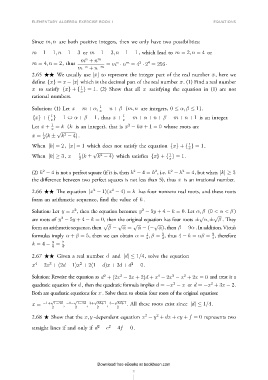
ELEMENTARY ALGEBRA EXERCISE BOOK I                                               equAtions


               Since  m, n  are both positive integers, then we only have two possibilities:

               m − 1 =1,n − 1= 3 or  m − 1 =3,n − 1= 1, which lead to  m =2,n =4 or
                                       n
               m =4,n =2, thus       m + n  m   = m · n =4 · 2 = 256 .
                                                               2
                                                         m
                                                     n
                                                                   4
                                    m −n  + n −m
               2.65     We usually use  [x] to represent the integer part of the real number  x, here we
               define {x} = x − [x] which is the decimal part of the real number x. (1) Find a real number
                                     1
               x  to satisfy  {x} + { } =1. (2) Show that all  x  satisfying the equation in (1) are not
                                     x
               rational numbers.
               Solution: (1) Let  x = m + α,  1  = n + β  (m, n  are integers,  0 ≤ α, β ≤ 1).
                                             x
                        1
                {x} + { } =1 ⇔ α + β =1, thus  x +      1  = m + α + n + β = m + n +1 is an integer.
                        x                               x
                                                          2
               Let  x +  1  = k  (k  is an integer), that is  x − kx +1 = 0 whose roots are
                        x
                          √
                    1         2
               x = (k ±     k − 4).
                    2
                                                                                     1
               When  |k| =2,  |x| =1 which does not satisfy the equation  {x} + { } =1.
                                                                                     x
                                          √
                                    1         2                             1
               When  |k|≥ 3,  x = (k ±      k − 4) which satisfies  {x} + { } =1.
                                    2                                       x
                                                                             2
                                                                                  2
               (2) k − 4 is not a perfect square (if it is, then k − 4= h , i.e. k − h =4, but when |k|≥ 3
                    2
                                                                      2
                                                            2
               the difference between two perfect squares is not less than 5), thus  x  is an irrational number.
               2.66    The equation (x − 1)(x − 4) = k  has four nonzero real roots, and these roots
                                           2
                                                   2
               form an arithmetic sequence, find the value of  k .
                                                                2
               Solution: Let  y = x , then the equation becomes  y − 5y +4 − k =0. Let α, β  (0 <α <β )
                                  2
                                                                                          √     √
               are roots of  y − 5y +4 − k =0, then the original equation has four roots ± α, ± β . They
                            2
                                               √     √      √        √
               form an arithmetic sequence, then  β −  α =    α − (− α), then β =9α . In addition, Vieta’s
                                                                                               9
                                                                         9
                                                                  1
               formulas imply α + β =5, then we can obtain α = ,β = , thus  4 − k = αβ = , therefore
                                                                  2      2                     4
                        9    7
               k =4 −     = .
                        4    4
               2.67     Given a real number  d  and  |d|≤ 1/4, solve the equation
                 4
                       3
                                     2
               x − 2x + (2d − 1)x + 2(1 − d)x +2d + d =0.
                                                           2
               Solution: Rewrite the equation as  d + (2x − 2x + 2)d + x − 2x − x +2x =0 and treat it a
                                                                       4
                                                                                   2
                                                                             3
                                               2
                                                      2
                                                                                               2
                                                                              2
               quadratic equation for d , then the quadratic formula implies d = −x − x  or d = −x +3x − 2.
               Both are quadratic equations for x . Solve them to obtain four roots of the original equation:
                        √         √        √        √
               x =  −1+ 1−4d −1− 1−4d 3+ 4d+1 3− 4d+1    . All these roots exist since  |d|≤ 1/4.
                                                ,
                             ,
                                       ,
                        2         2         2        2
                                                                 2
                                                                       2
               2.68   Show that the x, y -dependent equation x − y + dx + ey + f =0 represents two
               straight lines if and only if  d − e − 4f =0.
                                                 2
                                            2
                                            Download free eBooks at bookboon.com
                                                            71

