


Page 30 - downmagaz.com
P. 30
Home                                  from                           home


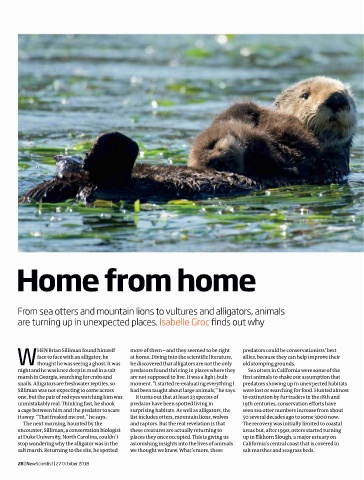
         From sea otters and mountain lions to vultures and alligators, animals

         are turning up in unexpected places. Isabelle Groc  nds out why


                 HEN Brian Silliman found himself        more of them – and they seemed to be right       predators could be conservationists’ best
                 face to face with an alligator, he      at home. Diving into the scientific literature,   allies, because they can help improve their
        Wthought he was seeing a ghost. It was           he discovered that alligators are not the only   old stomping grounds.
         night and he was knee deep in mud in a salt     predators found thriving in places where they      Sea otters in California were some of the
         marsh in Georgia, searching for crabs and       are not supposed to live. It was a light-bulb    first animals to shake our assumption that
         snails. Alligators are freshwater reptiles, so   moment. “I started re-evaluating everything I   predators showing up in unexpected habitats
         Silliman was not expecting to come across       had been taught about large animals,” he says.   were lost or searching for food. Hunted almost
         one, but the pair of red eyes watching him was     It turns out that at least 23 species of      to extinction by fur traders in the 18th and
         unmistakably real. Thinking fast, he shook      predator have been spotted living in             19th centuries, conservation efforts have
         a cage between him and the predator to scare    surprising habitats. As well as alligators, the   seen sea otter numbers increase from about
         it away. “That freaked me out,” he says.        list includes otters, mountain lions, wolves     50 several decades ago to some 3000 now.
           The next morning, haunted by the              and raptors. But the real revelation is that     The recovery was initially limited to coastal
         encounter, Silliman, a conservation biologist   these creatures are actually returning to        areas but, after 1990, otters started turning
         at Duke University, North Carolina, couldn’t    places they once occupied. This is giving us     up in Elkhorn Slough, a major estuary on
         stop wondering why the alligator was in the     astonishing insights into the lives of animals   California’s central coast that is covered in
         salt marsh. Returning to the site, he spotted   we thought we knew. What’s more, these           salt marshes and seagrass beds.


         28 | NewScientist | 27 October 2018

