


Page 32 - downmagaz.com
P. 32
“ It means there is much more habitat in

         which endangered species can recover”


         returning to their historical habitats in
         southern Europe as a result of humans
         moving out of the countryside and decreasing
         persecution of wildlife. Eagles and vultures
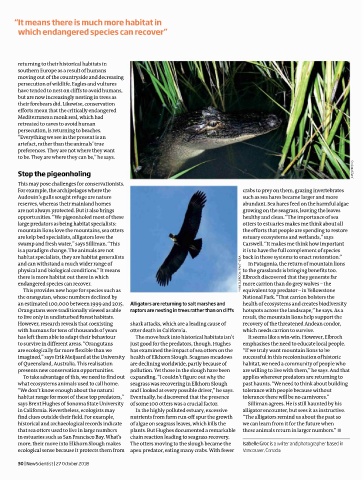
         have tended to nest on cliffs to avoid humans,
         but are now increasingly nesting in trees as
         their forebears did. Likewise, conservation
         efforts mean that the critically endangered
         Mediterranean monk seal, which had
         retreated to caves to avoid human
         persecution, is returning to beaches.
         “Everything we see in the present is an
         artefact, rather than the animals’ true
         preferences. They are not where they want
         to be. They are where they can be,” he says.
                                                                                                                                                         JAMES NIFONG

         Stop the pigeonholing

         This may pose challenges for conservationists.
         For example, the archipelagos where the                                                          crabs to prey on them, grazing invertebrates
         Audouin’s gulls sought refuge are nature                                                         such as sea hares became larger and more
         reserves, whereas their mainland homes                                                           abundant. Sea hares feed on the harmful algae
         are not always protected. But it also brings                                                     growing on the seagrass, leaving the leaves
         opportunities. “We pigeonholed most of these                                                     healthy and clean. “The importance of sea
         large predators as being habitat specialists:                                                    otters to estuaries makes me think about all
         mountain lions love the mountains, sea otters                                                    the efforts that people are spending to restore
         are kelp bed specialists, alligators love the                                                    estuary ecosystems and wetlands,” says
         swamp and fresh water,” says Silliman. “This                                                     Carswell. “It makes me think how important
         is a paradigm change. The animals are not                                                        it is to have the full complement of species
         habitat specialists, they are habitat generalists                                                back in those systems to enact restoration.”
         and can withstand a much wider range of                                                            In Patagonia, the return of mountain lions
         physical and biological conditions.” It means                                                    to the grasslands is bringing benefits too.
         there is more habitat out there in which                                                        MARK ELBROCH / PANTHERA  Elbroch discovered that they generate far
         endangered species can recover.                                                                  more carrion than do grey wolves – the
           This provides new hope for species such as                                                     equivalent top predator – in Yellowstone
         the orangutan, whose numbers declined by                                                         National Park. “That carrion bolsters the
         an estimated 100,000 between 1999 and 2015.     Alligators are returning to salt marshes and     health of ecosystems and creates biodiversity
         Orangutans were traditionally viewed as able    raptors are nesting in trees rather than on cliffs   hotspots across the landscape,” he says. As a
         to live only in undisturbed forest habitats.                                                     result, the mountain lions help support the
         However, research reveals that coexisting       shark attacks, which are a leading cause of      recovery of the threatened Andean condor,
         with humans for tens of thousands of years      otter death in California.                       which needs carrion to survive.
         has left them able to adapt their behaviour        The move back into historical habitats isn’t    It seems like a win-win. However, Elbroch
         to survive in different areas. “Orangutans      just good for the predators, though. Hughes      emphasises the need to educate local people.
         are ecologically far more flexible than we      has examined the impact of sea otters on the     “If we truly want mountain lions to be
         imagined,” says Erik Meijaard at the University  health of Elkhorn Slough. Seagrass meadows      successful in this recolonisation of historic
         of Queensland, Australia. This realisation      are declining worldwide, partly because of       habitat, we need a community of people who
         presents new conservation opportunities.        pollution. Yet those in the slough have been     are willing to live with them,” he says. And that
           To take advantage of this, we need to find out  expanding. “I couldn’t figure out why the      applies wherever predators are returning to
         what ecosystems animals used to call home.      seagrass was recovering in Elkhorn Slough        past haunts. “We need to think about building
         “We don’t know enough about the natural         and I looked at every possible driver,” he says.   tolerance with people because without
         habitat range for most of these top predators,”  Eventually, he discovered that the presence     tolerance there will be no carnivores.”
         says Brent Hughes of Sonoma State University    of some 100 otters was a crucial factor.           Silliman agrees. He is still haunted by his
         in California. Nevertheless, ecologists may        In the highly polluted estuary, excessive     alligator encounter, but sees it as instructive.
         find clues outside their field. For example,    nutrients from farm run-off spur the growth      “The alligators remind us about the past so
         historical and archaeological records indicate   of algae on seagrass leaves, which kills the    we can learn from it for the future when
         that sea otters used to live in large numbers   plants. But Hughes documented a remarkable       these animals return in larger numbers.”  ■
         in estuaries such as San Francisco Bay. What’s   chain reaction leading to seagrass recovery.
         more, their move into Elkhorn Slough makes      The otters moving to the slough became the       Isabelle Groc is a writer and photographer based in
         ecological sense because it protects them from  apex predator, eating many crabs. With fewer     Vancouver, Canada


         30 | NewScientist | 27 October 2018

