


Page 31 - downmagaz.com
P. 31
ISABELLE GROC                                                                                                            FLPA/ALAMY


          “When we first noticed that an ever larger    Unsurprisingly, we tend to associate them       It turns out that sea otters don’t
       number of sea otters were living in the slough,   with mountains. But historical records show    need to live in the sea, nor mountain
       we did not immediately grasp the fact that the   that in Patagonia they once lived in open       lions in the mountains
       slough could provide all their habitat needs,”   grasslands. As sheep farming became
       says Lilian Carswell from the US Fish and        established in South America, they were         These birds were thought to be small-island
       Wildlife Service. The remnant population of      persecuted – along with their prey, a kind of   specialists, so why were they abandoning
       otters had persisted exclusively on California’s  llama called a guanaco. As a result, mountain   their homes? His insight came when he visited
       coast, and conservationists had assumed this     lions survived only in the remote Andes away    Castro de Baroña, an Iron Age settlement on a
       is where they belonged, foraging in kelp beds.   from humans. But in the past 20 years, sheep    rugged peninsula in Galicia. “I realised it was a
       But the fact they were thriving in Elkhorn       ranching has declined. “We started to see a     terrible place to live, exposed to winter storms
       Slough forced a rethink. “We wiped out these     change,” says Mark Elbroch from conservation  and difficult to cultivate. My conclusion was
       species from most of their range long before                                                     that the Iron Age people built a village there
       we had ecology as a science,” says Carswell.   “ If ecologists want to                           because they were forced to do so,” he says.
       “There is so much we don’t know.”               understand the present,                            Suddenly, Martínez-Abraín saw the
          The story of California’s sea otters is not                                                   connection with the Audouin’s gulls. He
       a one-off. Earlier this year, Silliman and his   they should look at the past”                   realised that human persecution had forced
       colleagues revealed a wider trend in a paper                                                     the birds to leave their preferred mainland
       aptly titled “Are the ghosts of nature’s past    society Panthera. “The mountain lions that      habitat and eke out a living on the islands.
       haunting ecology today?”. As a result of         had been removed from the open grassland        Now, no longer threatened by humans, they
       conservation efforts, a variety of predators are   began to come back out of the mountains at    are returning to their historical homes – just
       reappearing in ecosystems they were pushed       the same time as the guanaco was beginning      as the people of Castro de Baroña moved to
       out of by hunting and development. “It is an     to move back into the grassland.”               more hospitable areas once the Roman Empire
       exciting time for ecologists,” says Carswell,      Such recolonisation is happening in           became peaceful. “We have been studying
       “because these species are coming back to        Europe too. Alejandro Martínez-Abraín at the    things from the wrong perspective. If
       these ecosystems from which they have            University of A Coruña, Spain, was puzzled to   ecologists want to understand the present,
       been absent for many human generations and       discover that ground-nesting Audouin’s gulls    they should look at the past,” he says.
       they are putting their house back in order.”     were relocating from archipelagos in the          Martínez-Abraín’s research, published
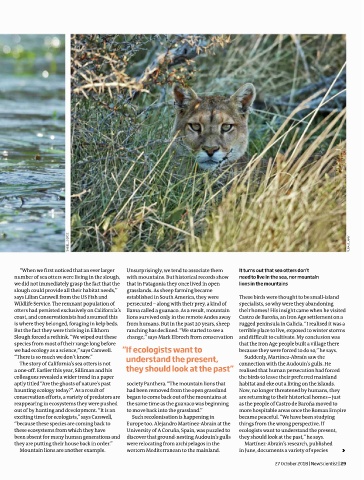
          Mountain lions are another example.           western Mediterranean to the mainland.          in June, documents a variety of species     >


                                                                                                                        27 October 2018 | NewScientist | 29

