


Page 158 - Basic Principles of Textile Coloration
P. 158
DYEHOUSE EFFLUENT AND ITS TREATMENT 147

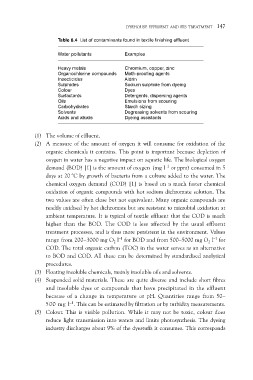
Table 8.4 List of contaminants found in textile finishing effluent

Water pollutants          Examples

Heavy metals              Chromium, copper, zinc
Organochlorine compounds  Moth-proofing agents
Insecticides              Aldrin
Sulphides                 Sodium sulphide from dyeing
Colour                    Dyes
Surfactants               Detergents, dispersing agents
Oils                      Emulsions from scouring
Carbohydrates             Starch sizing
Solvents                  Degreasing solvents from scouring
Acids and alkalis         Dyeing assistants

(1) The volume of effluent.
(2) A measure of the amount of oxygen it will consume for oxidation of the

      organic chemicals it contains. This point is important because depletion of
      oxygen in water has a negative impact on aquatic life. The biological oxygen
      demand (BOD) [1] is the amount of oxygen (mg l–1 or ppm) consumed in 5
      days at 20 °C by growth of bacteria from a culture added to the water. The
      chemical oxygen demand (COD) [1] is based on a much faster chemical
      oxidation of organic compounds with hot sodium dichromate solution. The
      two values are often close but not equivalent. Many organic compounds are
      readily oxidised by hot dichromate but are resistant to microbial oxidation at
      ambient temperature. It is typical of textile effluent that the COD is much
      higher than the BOD. The COD is less affected by the usual effluent
      treatment processes, and is thus more persistent in the environment. Values
      range from 200–3000 mg O2 l–1 for BOD and from 500–5000 mg O2 l–1 for
      COD. The total organic carbon (TOC) in the water serves as an alternative
      to BOD and COD. All these can be determined by standardised analytical
      procedures.
(3) Floating insoluble chemicals, mainly insoluble oils and solvents.
(4) Suspended solid materials. These are quite diverse and include short fibres
      and insoluble dyes or compounds that have precipitated in the effluent
      because of a change in temperature or pH. Quantities range from 50–
      5 0 0 m g l–1. This can be estimated by filtration or by turbidity measurements.
(5) Colour. This is visible pollution. While it may not be toxic, colour does
      reduce light transmission into waters and limits photosynthesis. The dyeing
      industry discharges about 9% of the dyestuffs it consumes. This corresponds

