


Page 153 - Basic Principles of Textile Coloration
P. 153
142 WATER TREATMENT

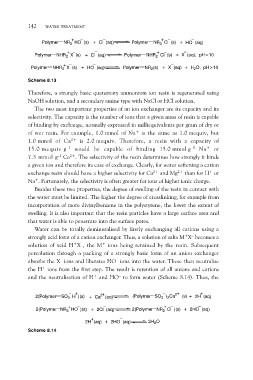
Polymer NR3 HO (s) + Cl (aq)      Polymer NR3 Cl (s) + HO (aq)

Polymer NHR2 X (s) + Cl (aq)      Polymer NHR2 Cl (s) + X (aq), pH<10

Polymer NHR2 X (s) + HO (aq)      Polymer NR2(s) + X (aq) + H2O, pH>10

Scheme 8.13

Therefore, a strongly basic quaternary ammonium ion resin is regenerated using
NaOH solution, and a secondary amine type with NaCl or HCl solution.

   The two most important properties of an ion exchanger are its capacity and its
selectivity. The capacity is the number of ions that a given mass of resin is capable
of binding by exchange, normally expressed in milliequivalents per gram of dry or
of wet resin. For example, 1.0 mmol of Na+ is the same as 1.0 mequiv, but
1.0 mmol of Ca2+ is 2.0 mequiv. Therefore, a resin with a capacity of
15.0 mequiv g–1 would be capable of binding 15.0 mmol g–1 Na+ or
7.5 mmol g–1 Ca2+. The selectivity of the resin determines how strongly it binds
a given ion and therefore its ease of exchange. Clearly, for water softening a cation
exchange resin should have a higher selectivity for Ca2+ and Mg2+ than for H+ or
Na+. Fortunately, the selectivity is often greater for ions of higher ionic charge.

   Besides these two properties, the degree of swelling of the resin in contact with
the water must be limited. The higher the degree of crosslinking, for example from
incorporation of more divinylbenzene in the polystyrene, the lower the extent of
swelling. It is also important that the resin particles have a large surface area and
that water is able to penetrate into the surface pores.

   Water can be totally demineralised by firstly exchanging all cations using a
strongly acid form of a cation exchanger. Thus, a solution of salts M+X– becomes a
solution of acid H+X–, the M+ ions being retained by the resin. Subsequent
percolation through a packing of a strongly basic form of an anion exchanger
absorbs the X– ions and liberates HO– ions into the water. These then neutralise
the H+ ions from the first step. The result is retention of all anions and cations
and the neutralisation of H+ and HO– to form water (Scheme 8.14). Thus, the

2(Polymer SO3 H )(s) + Ca2 (aq)   (Polymer SO3 )2Ca2 (s) + 2H (aq)

2(Polymer NR3 HO )(s) + 2Cl (aq)  2(Polymer NR3 Cl )(s) + 2HO (aq)

             2H (aq) + 2HO (aq)   2H2O

Scheme 8.14

