


Page 282 - Basic Principles of Textile Coloration
P. 282
DYEING NYLON WITH ACID DYES 271

the available ammonium ion sites in the nylon at one third the molar quantity of a
dye with a single sulphonate group. For a nylon with 45 mmol kg–1 of amino
groups, the maximum dye adsorption of a trisulphonate dye is 15 mmol kg–1.
This corresponds to less than a 0.9 % owf dyeing for an acid dye with a molecular
weight less than 600. The equilibrium molar dye adsorption at saturation of a
polysulphonated acid dye of known molecular weight and purity is, in fact, a good
method of determining the amino group content of the nylon. The limited number
of ammonium ion sites in nylon, when dyeing with acid dyes under weakly acidic
conditions, poses problems in dyeing deep shades. In particular, the production of
blacks and other deep shades is problematic, since the amount of dye that
saturates all the ammonium ion sites is insufficient to give the depth of colour
required.

   The non-polar environment inside nylon filaments, and the large separation
between the amino and carboxyl groups, may not favour a zwitterionic form in
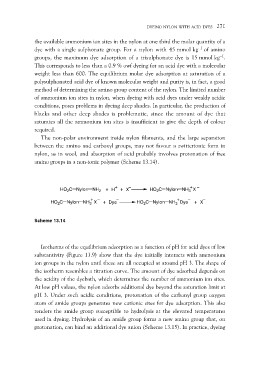
nylon, as in wool, and absorption of acid probably involves protonation of free
amino groups in a non-ionic polymer (Scheme 13.14).

HO2C Nylon NH2 + H + X  HO2C Nylon NH3 X

HO2C Nylon NH3 X + Dye  HO2C Nylon NH3 Dye + X

Scheme 13.14

   Isotherms of the equilibrium adsorption as a function of pH for acid dyes of low
substantivity (Figure 13.9) show that the dye initially interacts with ammonium
ion groups in the nylon until these are all occupied at around pH 3. The shape of
the isotherm resembles a titration curve. The amount of dye adsorbed depends on
the acidity of the dyebath, which determines the number of ammonium ion sites.
At low pH values, the nylon adsorbs additional dye beyond the saturation limit at
pH 3. Under such acidic conditions, protonation of the carbonyl group oxygen
atom of amide groups generates new cationic sites for dye adsorption. This also
renders the amide group susceptible to hydrolysis at the elevated temperatures
used in dyeing. Hydrolysis of an amide group forms a new amino group that, on
protonation, can bind an additional dye anion (Scheme 13.15). In practice, dyeing

