


Page 283 - Basic Principles of Textile Coloration
P. 283
272 ACID, PRE-METALLISED AND MORDANT DYES

CH2CH2 NH CO CH2CH2 + H                    CH2CH2 NH COH CH2CH2
CH2CH2 NH COH CH2CH2 + H2O                   CH2CH2 NH3 + HO2C CH2CH2

Scheme 13.15
                       90

Adsorbed dye/equiv kg–1                                                 High sustantivity
                         45 Fibre

                                                                                      saturation

                                           Low substantivity

                           24      68

                               pH

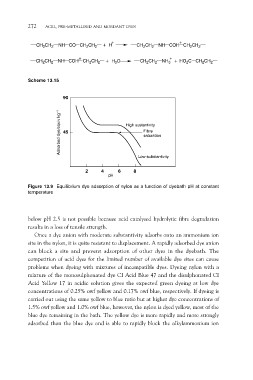
Figure 13.9 Equilibrium dye adsorption of nylon as a function of dyebath pH at constant
temperature

below pH 2.5 is not possible because acid catalysed hydrolytic fibre degradation
results in a loss of tensile strength.

   Once a dye anion with moderate substantivity adsorbs onto an ammonium ion
site in the nylon, it is quite resistant to displacement. A rapidly adsorbed dye anion
can block a site and prevent adsorption of other dyes in the dyebath. The
competition of acid dyes for the limited number of available dye sites can cause
problems when dyeing with mixtures of incompatible dyes. Dyeing nylon with a
mixture of the monosulphonated dye CI Acid Blue 47 and the disulphonated CI
Acid Yellow 17 in acidic solution gives the expected green dyeing at low dye
concentrations of 0.25% owf yellow and 0.17% owf blue, respectively. If dyeing is
carried out using the same yellow to blue ratio but at higher dye concentrations of
1.5% owf yellow and 1.0% owf blue, however, the nylon is dyed yellow, most of the
blue dye remaining in the bath. The yellow dye is more rapidly and more strongly
adsorbed than the blue dye and is able to rapidly block the alkylammonium ion

