


Page 309 - Basic Principles of Textile Coloration
P. 309
298 DYEING CELLULOSIC FIBRES WITH DIRECT DYES

the negative surface potential more effectively, thus decreasing the repulsion of
approaching dye anions. Polyvalent metal salts are, however, much more expensive
than sodium chloride, the usual choice of the dyer.

14.4.2 The effect of temperature

Increasing temperature increases the rate of dyeing and of dye migration. From Le
Chatelier’s principle for an exothermic dyeing equilibrium, the exhaustion will
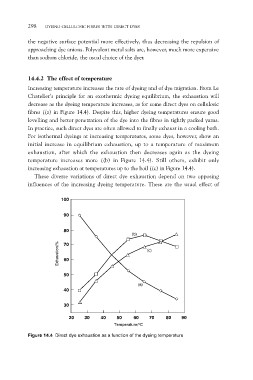
decrease as the dyeing temperature increases, as for some direct dyes on cellulosic
fibres ((a) in Figure 14.4). Despite this, higher dyeing temperatures ensure good
levelling and better penetration of the dye into the fibres in tightly packed yarns.
In practice, such direct dyes are often allowed to finally exhaust in a cooling bath.
For isothermal dyeings at increasing temperatures, some dyes, however, show an
initial increase in equilibrium exhaustion, up to a temperature of maximum
exhaustion, after which the exhaustion then decreases again as the dyeing
temperature increases more ((b) in Figure 14.4). Still others, exhibit only
increasing exhaustion at temperatures up to the boil ((c) in Figure 14.4).

   These diverse variations of direct dye exhaustion depend on two opposing
influences of the increasing dyeing temperature. These are the usual effect of

              100

              90

Exhaustion/%  80
                                                                 (b)

              70
                                                                             (c)

              60

              50

                                                                      (a)
              40

              30

                   20 30  40 50 60 70                                             80 90
                                    Temperature/oC

Figure 14.4 Direct dye exhaustion as a function of the dyeing temperature

