


Page 313 - Basic Principles of Textile Coloration
P. 313
302 DYEING CELLULOSIC FIBRES WITH DIRECT DYES

                     CH3O  9   OCH3
             OH            10             HO

                     N              N
                  N                    N

             HH                      H
                 O                      OH

                  Cu O         O Cu
             O                              O

                     N             N
                  N                    N

Figure 14.6

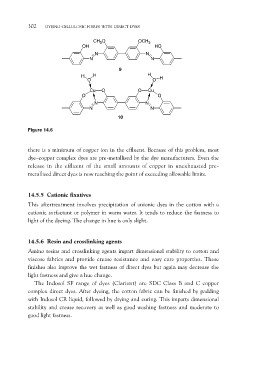
there is a minimum of copper ion in the effluent. Because of this problem, most
dye–copper complex dyes are pre-metallised by the dye manufacturers. Even the
release in the effluent of the small amounts of copper in unexhausted pre-
metallised direct dyes is now reaching the point of exceeding allowable limits.

14.5.5 Cationic fixatives

This aftertreatment involves precipitation of anionic dyes in the cotton with a
cationic surfactant or polymer in warm water. It tends to reduce the fastness to
light of the dyeing. The change in hue is only slight.

14.5.6 Resin and crosslinking agents

Amino resins and crosslinking agents impart dimensional stability to cotton and
viscose fabrics and provide crease resistance and easy care properties. These
finishes also improve the wet fastness of direct dyes but again may decrease the
light fastness and give a hue change.

   The Indosol SF range of dyes (Clariant) are SDC Class B and C copper
complex direct dyes. After dyeing, the cotton fabric can be finished by padding
with Indosol CR liquid, followed by drying and curing. This imparts dimensional
stability and crease recovery as well as good washing fastness and moderate to
good light fastness.

