


Page 388 - Basic Principles of Textile Coloration
P. 388
DYEING WITH INDIGO AND INDIGOID VAT DYES 377

17.9.1 Application of Indigo to cotton
Dyeing cotton yarn for blue jeans is an important use of Indigo. In a typical batch
operation, concentrated reduced Indigo is added to a dyebath from which oxygen
has been removed with a little alkaline hydros. The goods are entered and fully
immersed to avoid oxidation. After about 15 min at 20–25 °C, the goods are
removed and well squeezed before air oxidation. Indigo does not exhaust well
because of its limited substantivity for cotton, not surprising considering its small
molecular size (Figure 1.4). Deep shades must be built up by repeated dipping in
the dyebath after each oxidation. The use of too concentrated a dyebath is not
effective for deep shades as it results in poor rubbing fastness. Some salt may be
added to aid exhaustion. After dyeing, the goods are well soaped. The final dyed
material may be aftertreated to produce a faded, worn look.

   Continuous methods are used for dyeing ball warps, warp beams and piece
goods with Indigo. This is usually carried out in a series of 4–6 wash boxes with
upper and lower rollers and nips at the exits. The goods are threaded through each
box and may be skyed at the mid-point. The first box is used to wet out the
material. In subsequent boxes, the goods are immersed in the leuco Indigo solution
for 10–30 s at a linear speed of about 25 m min–1, squeezed and skyed for 2 min
to oxidise the leuco dye to Indigo. The boxes are fed with a stock vat of leuco
Indigo and the liquor in the boxes is circulated to maintain constant dyeing
conditions. This process of several dips and oxidations is then repeated in a second
series of boxes, and so on. Several rinsing and washing boxes complete the process.

17.9.2 Indigoid vat dyes
Besides Indigo itself, there are a number of other important indigo and thioindigo
derivatives used for dyeing cellulosic fibres. These include chlorinated and
brominated indigo and thioindigo dyes in which the nitrogen atoms of Indigo are
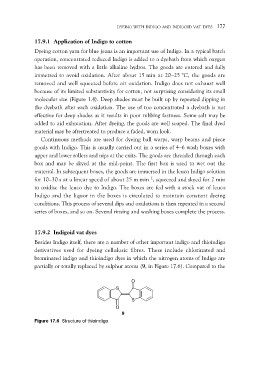
partially or totally replaced by sulphur atoms (9, in Figure 17.6). Compared to the

                                                                O
                                                      S

                                                                S
                                                      O

                                                          9
Figure 17.6 Structure of thioindigo

