


Page 389 - Basic Principles of Textile Coloration
P. 389
378 VAT DYES

anthraquinone type vat dyes, Indigoid vat dyes give much paler yellow to brown
leuco compound solutions. The vatting process is also slower and requires less
alkali.

17.10 SOLUBILISED VAT DYES

The solubilised vat dyes provided a means of avoiding the difficult vatting process
required for quinone and indigoid vat dyes. The preparation of a solution of a
leuco vat dye requires care and time, and protection of the solution from excessive
exposure to air. The solubilised vat dyes avoid these problems. These dyes are pre-
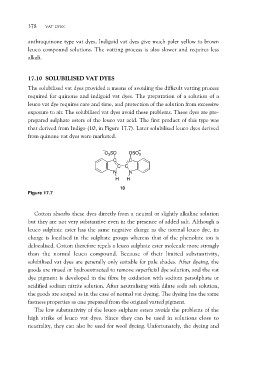
prepared sulphate esters of the leuco vat acid. The first product of this type was
that derived from Indigo (10, in Figure 17.7). Later solubilised leuco dyes derived
from quinone vat dyes were marketed.

             O3SO         OSO3
                  C       C
                     C  C
                  N       N

             HH

             10

Figure 17.7

   Cotton absorbs these dyes directly from a neutral or slightly alkaline solution
but they are not very substantive even in the presence of added salt. Although a
leuco sulphate ester has the same negative charge as the normal leuco dye, its
charge is localised in the sulphate groups whereas that of the phenolate ion is
delocalised. Cotton therefore repels a leuco sulphate ester molecule more strongly
than the normal leuco compound. Because of their limited substantivity,
solubilised vat dyes are generally only suitable for pale shades. After dyeing, the
goods are rinsed or hydroextracted to remove superficial dye solution, and the vat
dye pigment is developed in the fibre by oxidation with sodium persulphate or
acidified sodium nitrite solution. After neutralising with dilute soda ash solution,
the goods are soaped as in the case of normal vat dyeing. The dyeing has the same
fastness properties as one prepared from the original vatted pigment.

   The low substantivity of the leuco sulphate esters avoids the problems of the
high strike of leuco vat dyes. Since they can be used in solutions close to
neutrality, they can also be used for wool dyeing. Unfortunately, the dyeing and

