


Page 97 - Basic Principles of Textile Coloration
P. 97
Reflectance /%86 NATURAL CELLULOSIC FIBRES

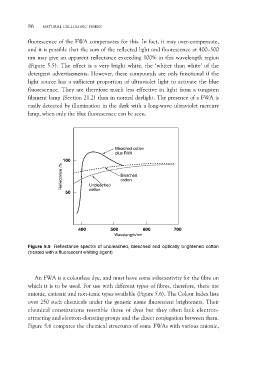
fluorescence of the FWA compensates for this. In fact, it may over-compensate,
and it is possible that the sum of the reflected light and fluorescence at 400–500
nm may give an apparent reflectance exceeding 100% in this wavelength region
(Figure 5.5). The effect is a very bright white, the ‘whiter than white’ of the
detergent advertisements. However, these compounds are only functional if the
light source has a sufficient proportion of ultraviolet light to activate the blue
fluorescence. They are therefore much less effective in light from a tungsten
filament lamp (Section 21.2) than in normal daylight. The presence of a FWA is
easily detected by illumination in the dark with a long-wave ultraviolet mercury
lamp, when only the blue fluorescence can be seen.

                                                                  Bleached cotton
                                                                  plus FWA
                       100

                                                                      Bleached
                                                                      cotton
                                              Unbleached
                        50 cotton

                                 400 500 600 700
                                                                 Wavelength/nm

Figure 5.5 Reflectance spectra of unbleached, bleached and optically brightened cotton
(treated with a fluorescent whiting agent)

   An FWA is a colourless dye, and must have some substantivity for the fibre on
which it is to be used. For use with different types of fibres, therefore, there are
anionic, cationic and non-ionic types available (Figure 5.6). The Colour Index lists
over 250 such chemicals under the generic name fluorescent brighteners. Their
chemical constitutions resemble those of dyes but they often lack electron-
attracting and electron-donating groups and the direct conjugation between them.
Figure 5.6 compares the chemical structures of some FWAs with various anionic,

